
live better, longer
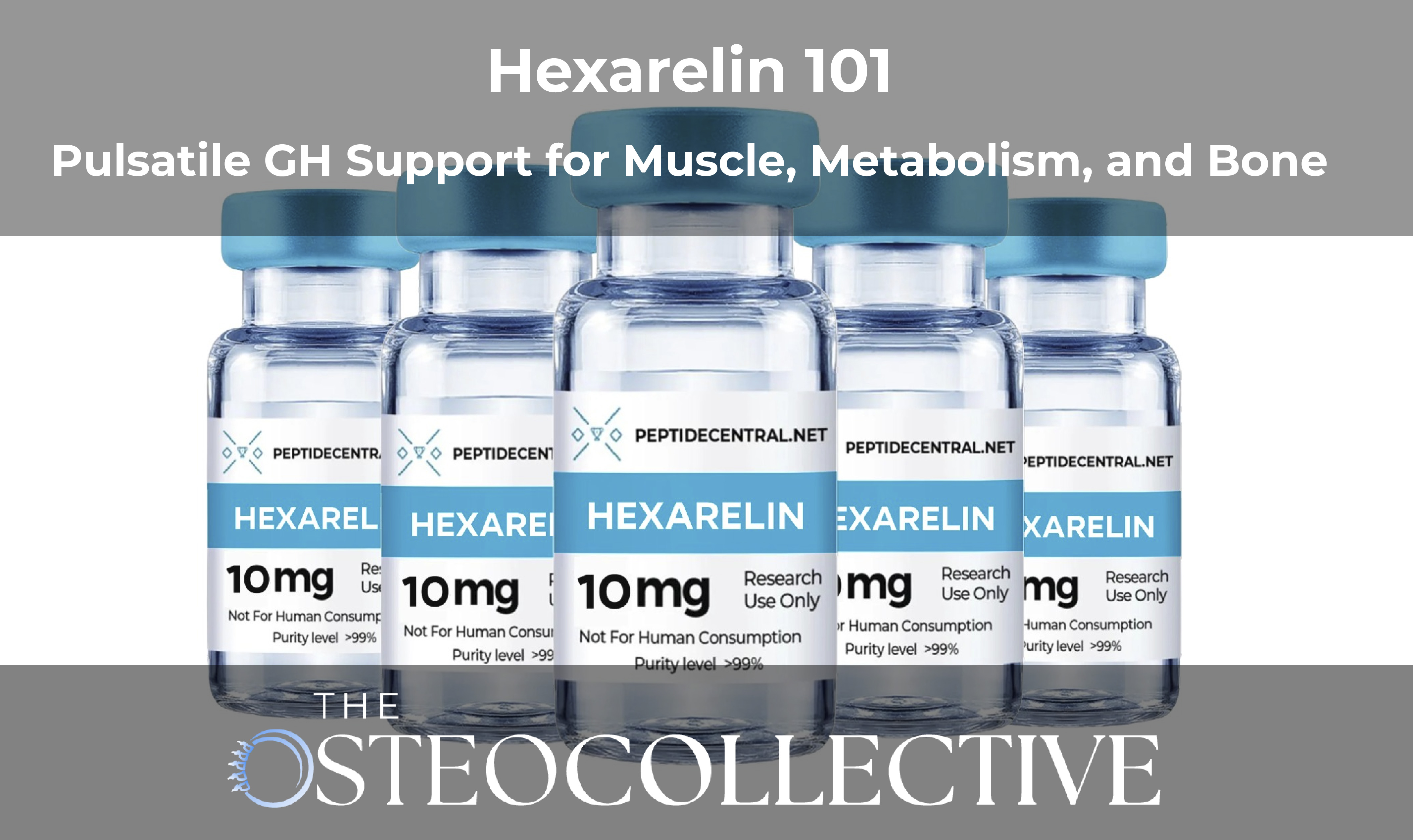
If you follow this channel, you know we’re always hunting for safe, practical tools to improve bone, muscle, and metabolic health. Today’s topic is a lesser-known peptide called hexarelin. It isn’t a magic wand, but the research is intriguing: improved lean mass in animals, better insulin sensitivity and lipid markers, potential cardiovascular support, and—in a rodent model—signals that it may blunt bone loss. Below I’ll summarize what hexarelin is, what the data actually show, how we think about dosing and safety, and where it might fit (and might not) in a bone-health program.
Hexarelin is a short chain of amino acids (a peptide) that signals your brain to release growth hormone (GH) by activating the growth hormone secretagogue receptor (a ghrelin-family target). The important bit isn’t trivia; it’s how it stimulates GH: in pulses, more like your body naturally does. That matters because constant GH elevation can have downsides, while pulsatile release tends to preserve feedback control and reduce risk.
Hexarelin is not a prescription, FDA-approved drug for bone health in the U.S. It sits in the “research/compounding” world alongside other clinically used peptides. That means access typically flows through trained clinicians and 503A/503B compounding pharmacies, not retail shelves.
Bone is tightly coupled to muscle and metabolism. When you improve lean mass, reduce visceral fat, and nudge insulin sensitivity in the right direction, you set the stage for better training outcomes and, potentially, a friendlier bone-building environment. Hexarelin’s value proposition is less “direct bone drug” and more “systemic nudge” that supports the conditions bones prefer—especially when paired with impact/resistance training and adequate protein.
Most hexarelin data are preclinical, with a handful of human studies focusing on endocrine and cardiovascular effects. Here’s the signal, separated from the noise:
Takeaway: we have promising physiology + plausible mechanisms across metabolism, muscle, and vascular function, and an animal signal for preserving bone. We do not yet have large, long human trials proving fracture reduction or DEXA gains. So we treat it as an adjunct—a potential accelerator—never a standalone fix.
Big picture first: bones respond best to force + fuel + hormones + sleep. That’s resistance/impact training, adequate protein (generally ~1.6–2.2 g/kg/day for lifters or those trying to regain), vitamin D/K2/minerals, and appropriate hormone optimization (e.g., HRT/androgen support when clinically indicated). If those pillars are weak, no peptide will save the day.
Hexarelin is a candidate add-on when:
Sleep (7–9 hours) and stress modulation (meditation/breathwork).

Peptides are powerful—and dosing mistakes are the fast lane to side effects. That’s why we strongly recommend clinician oversight and legit compounding pharmacies.
Bottom line on safety: within common clinic doses, hexarelin has looked well-tolerated in published work and in practice; still, everything has trade-offs. Supervise, measure, and cycle intelligently.
If you have a history of active malignancy, uncontrolled diabetes, severe sleep apnea, significant edema, or you’re pregnant/breastfeeding—this lane isn’t for you. Anyone with cardiovascular disease should clear peptide plans with their cardiology team. And if you’re unwilling to shore up training, protein, and sleep, peptides won’t provide durable benefit.
We start with a 4–8 week “fundamentals” block: protein targets, creatine, progressive strength+impact plan, sleep standardization, vitamin D/K2/magnesium dialed in. If lean mass and training performance are still lagging—and labs look appropriate—we consider hexarelin for 8–12 weeks, paired with a structured progression (think heavier compounds, lower-rep strength blocks). We reassess body comp, strength, energy, and recovery every 4 weeks, then decide whether to extend, cycle off, or park it.
Hexarelin isn’t a bone drug. It is a potentially useful systems-level lever: better muscle, better metabolic tone, possibly friendlier vascular signaling—and in animals, less bone loss in estrogen-deficient states. For the right person, under clinical supervision, it can be a smart adjunct that helps your training and nutrition do more work per rep and per gram of protein. If you’re still building your foundation, start there first. If your foundation is solid and progress has stalled, hexarelin is a reasonable, monitored experiment.
Medical Disclaimer
This article is educational and not medical advice. Peptides and supplements can interact with conditions and medications. Talk with your clinician before starting, stopping, or changing any therapy.
Your Blueprint for Lasting Bone Health and Longevity

.svg)
.svg)
.svg)
.svg)


Join us LIVE October 1st, 2026 at 3:00pm EST to Learn Dr. Doug's proven framework for Osteoporosis Reversal for FREE. Yes! Reversing Osteoporosis is possible and has happened for hundreds of Dr. Doug's patients.
If you have been blind-sided, feel stuck, confused, and exhausted with your diagnosis, this Masterclass is for you!

.svg)

.svg)
