
live better, longer
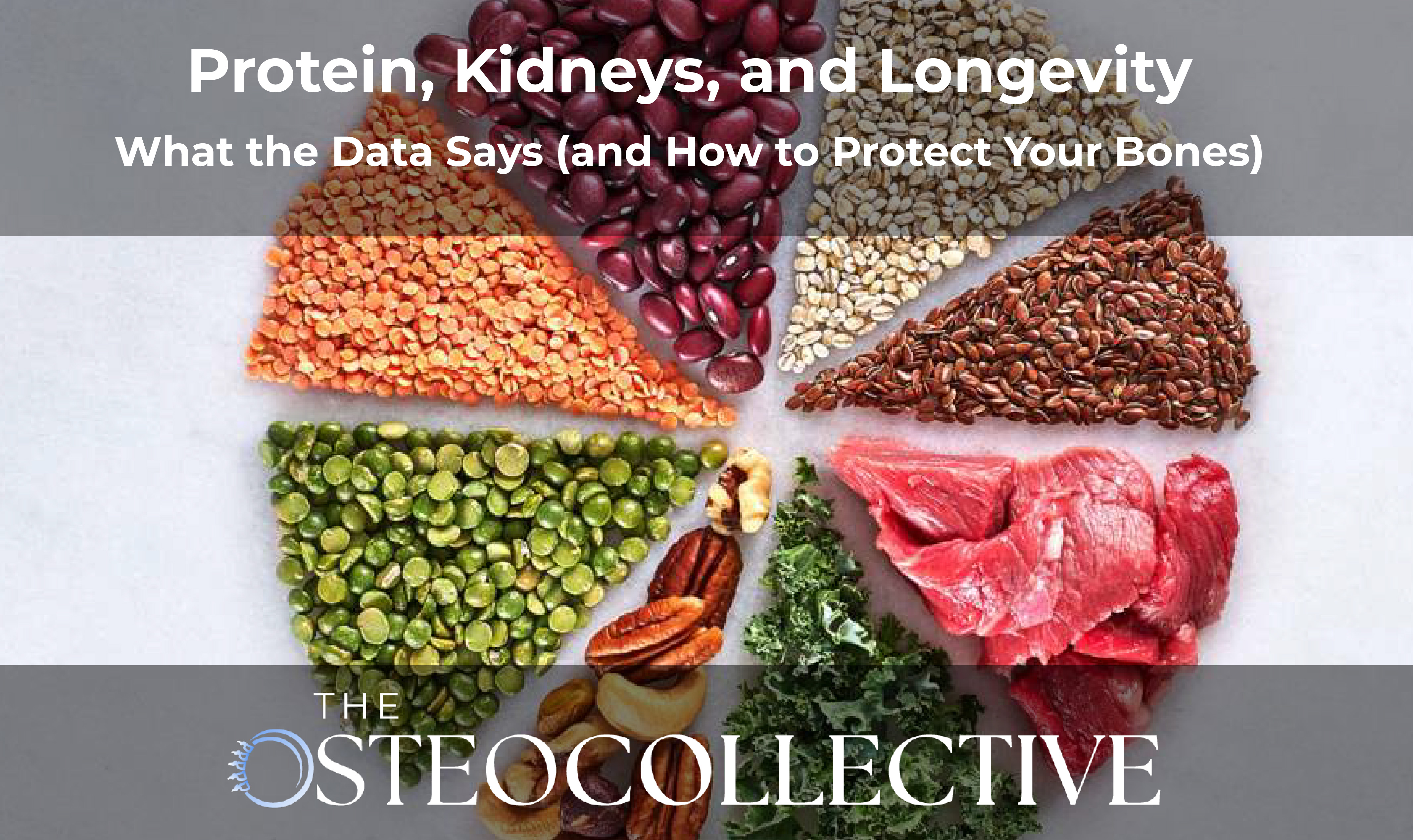
If you’ve followed my work, you’ve heard me beat the drum on protein for bone health. Across large populations, higher protein intake tracks with higher bone mineral density. But anytime we talk protein, the internet quickly jumps to cancer, kidneys, IGF-1, mTOR… and before long, people are scared into eating less of the very macronutrient their bones and muscles need most. Let’s clear this up with what current research actually says—then translate it into practical steps you can use today, including if you’ve been told you have chronic kidney disease (CKD).
Quick disclaimer: This is educational, not medical advice. If you have CKD or any medical condition, discuss changes with your clinician.
A recent analysis leveraging the Nurses’ Health Study followed ~49,000 women for ~30 years. Higher protein intake in midlife was linked to better odds of “healthy aging”—defined as being free of 11 major chronic diseases (kidney disease included), with intact physical, cognitive, and mental health. That’s not a subtle finding. In this cohort, more protein did not translate to more kidney disease.
A 2024 meta-analysis with >150,000 participants found the same direction of effect: higher total protein intake correlated with a lower risk of CKD diagnosis. Interestingly, within that analysis, the plant-protein subgroup showed mixed signals in some cuts of the data. That sounds confusing until you remember diet quality matters: whole-food plant proteins are a different universe from ultra-processed “plant-based” products. Lumping them together muddies the water.
Bottom line so far: in people without CKD, higher protein intake has not been shown to harm kidneys and may associate with better long-term outcomes.
A 2022 NHANES analysis (8,000+ people, ~5 years follow-up) asked a direct question: does a low-protein diet (<0.8 g/kg) protect against death, especially across different levels of kidney function? The finding: kidney function itself predicts mortality (worse function → higher mortality), but eating low protein didn’t deliver a mortality advantage at any kidney function level. Add to this a meta-analysis of 28 studies concluding high-protein intake does not adversely affect kidney function in healthy adults. The narrative that “high protein = early death” just isn’t supported by data when you control for the right variables.
You may have seen the KDOQI 2020 guidance recommending 0.55–0.60 g/kg/day (and even lower in some very-low-protein protocols) for metabolically stable CKD stages 3–5 to slow progression. Two important realities here:
A fair synthesis looks like this:
A single low eGFR value on a lab printout does not equal CKD. True CKD requires persistent reduction in eGFR for ≥3 months and/or evidence of kidney damage (e.g., protein in the urine) on validated testing. eGFR itself is an estimate influenced by age, sex, race, and muscle mass. Before you change your life around one datapoint, confirm the diagnosis properly with your clinician.
Here’s the tradeoff almost no one discusses: low-protein diets accelerate loss of muscle (sarcopenia) and make it harder to rebuild bone. Bone is protein + mineral. To reverse osteoporosis, you need the raw materials (amino acids), the signal (impact/resistance training), the hormonal milieu (e.g., estrogen/progesterone ± androgens when appropriate), and adequate micronutrients (D, K2, calcium, magnesium, trace minerals). Chronic protein restriction undercuts the entire plan.
For most adults pursuing bone health and longevity, a practical target is:
Not sure what’s “right” for your situation? Join our free Bone Health Masterclass and bring your questions to the live Q&A—we cover protein, training, and labs in a clean, step-by-step framework. (Link in post CTA below.)
If you’ve been told you have CKD—or you’re on the border—here’s a collaborative approach to discuss with your clinician:
For most people, especially those aiming to reverse osteoporosis, avoiding protein is the wrong lever. In healthy kidneys, higher protein hasn’t been shown to cause CKD or increase mortality. In CKD, the story is nuanced and individualized—but even there, blanket restriction isn’t a silver bullet and can backfire if it costs you muscle and independence.
You won’t build bone without adequate protein. Choose quality, hit realistic targets, train smart, optimize hormones and micronutrients, and track the right markers. That’s how you protect your healthspan now—without waiting for perfect answers or scary headlines to settle.
Still unsure what protein target is right for you—or how to balance it with kidney labs and bone goals? Join our free Bone Health Masterclass and bring your questions to the live Q&A. Prefer ongoing support? Come inside The OsteoCollective and get coaching, resources, and a community that keeps you moving forward.

Your Blueprint for Lasting Bone Health and Longevity

.svg)
.svg)
.svg)
.svg)


Join us LIVE October 1st, 2026 at 3:00pm EST to Learn Dr. Doug's proven framework for Osteoporosis Reversal for FREE. Yes! Reversing Osteoporosis is possible and has happened for hundreds of Dr. Doug's patients.
If you have been blind-sided, feel stuck, confused, and exhausted with your diagnosis, this Masterclass is for you!

.svg)

.svg)
