
live better, longer
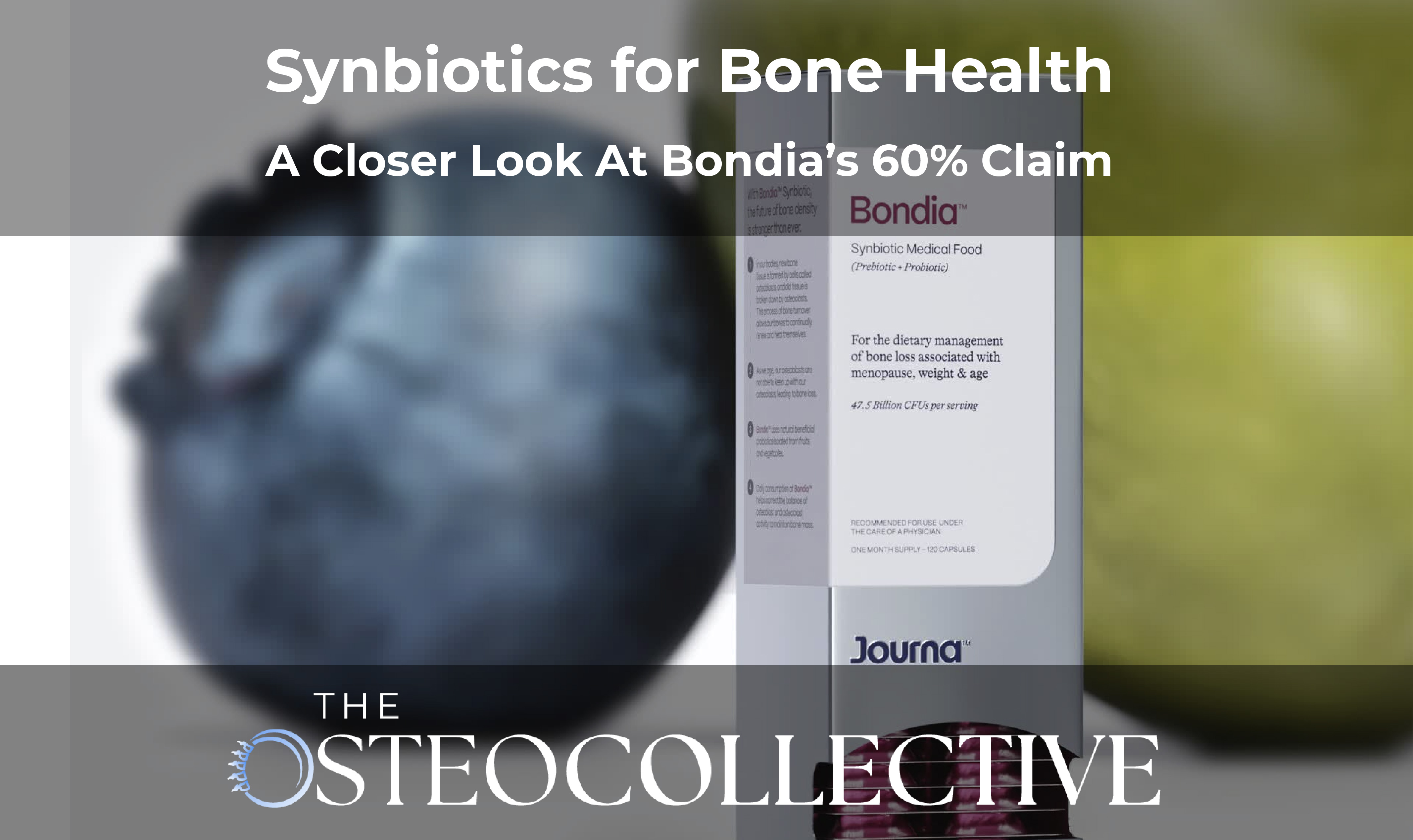
If you’ve seen the ads for Bondia—a “synbiotic medical food” by Jorna that “reduces bone loss by 60%”—you probably had the same reaction I did: bold claim… show me the details. Below I’ll break down what Bondia is, what we actually know about its study so far, how it’s supposed to work (SCFAs and K2), and how I’d use this lever in a real-world bone health program today.
Synbiotic = prebiotic + probiotic.
Bondia combines four probiotic strains with two prebiotics (powdered organic blueberries and oligofructose). The idea is to nourish your gut bacteria (prebiotics) while adding targeted strains (probiotics) that together:
It’s positioned specifically for early postmenopausal women—the window where bone loss accelerates if you’re not on hormone therapy.
Bondia’s headline stat comes from a randomized, blinded, placebo-controlled trial that (as of this writing) hasn’t been fully published yet. What we do know from the clinical trial listing and parent-company materials:
That’s a credible design and a smart population choice if your goal is to detect change. But two context notes:
Bottom line: design looks reasonable; conclusions should wait for peer-reviewed data.
Bondia leans on two mechanistic levers:
Acetate, propionate, and butyrate—made when gut microbes ferment fiber—appear to:
Food first still works: You can boost SCFAs by eating 20–30g/day of mixed fibers and resistant starches:
Bondia includes oligofructose (a FOS) and blueberry powder—essentially a targeted, convenient way to push the same lever.
Some gut strains can produce vitamin K₂ (MK variants), which supports calcium handling and bone proteins (e.g., osteocalcin). Caveat: K₂ is absorbed in the small intestine, while most microbial K₂ production happens deeper in the colon. Translation: much of that microbially produced K₂ may not be absorbed efficiently.
That’s why, in clinic, I still prefer direct K₂ intake:
In that case, Bondia may have little additive upside—and its value would come down to personal tolerance, convenience, and cost.
To judge the “60%” claim, the manuscript should clarify:
Dream follow-up: Head-to-head Bondia vs “Food+K₂” protocol (dietary fiber to 25–30g/day + standardized K₂ dose). That would tell us if the synbiotic adds unique value beyond fundamentals.

Until then, if you’re early postmenopause and not on HRT, Bondia could be a reasonable convenience play—provided your foundation (protein, minerals, D₃/K₂, training, sleep/stress) is in place. If your foundation isn’t set, start there first—you’ll get more reliable returns.
Is a synbiotic necessary if I already eat a high-fiber diet?
Maybe not. If you’re truly hitting 20–30g/day with a mix of fermentable fibers and resistant starch—and your gut tolerates it—you’re already pressing the SCFA lever.
Can the microbiome give me all the K₂ I need?
Unlikely. Production is mostly in the colon, but absorption is higher in the small intestine. Food/supplement K₂ is still the most dependable route.
Will I see DEXA change in 12 months?
Sometimes—especially in early postmenopause—but small effects can hide within DEXA’s variance. Bone turnover markers and (where available) qCT can catch earlier shifts.
Bondia’s claim is intriguing, the mechanism is plausible, and the trial design appears thoughtful. But until the data are peer-reviewed and published, I’d treat Bondia as a convenient adjunct, not a replacement for fundamentals. Build your base (protein, minerals, D₃/K₂, fiber/resistant starch, resistance + impact training, sleep, stress tools), then consider layering a synbiotic if you want an extra nudge—especially in that first 0–6 years postmenopause.
Want help stitching all of this together into a plan you’ll actually follow? Join our free Bone Health Masterclass—we walk through the top five mistakes that stall progress and show you how to build a sustainable, evidence-based stack.
Your Blueprint for Lasting Bone Health and Longevity

.svg)
.svg)
.svg)
.svg)


Join us LIVE October 1st, 2026 at 3:00pm EST to Learn Dr. Doug's proven framework for Osteoporosis Reversal for FREE. Yes! Reversing Osteoporosis is possible and has happened for hundreds of Dr. Doug's patients.
If you have been blind-sided, feel stuck, confused, and exhausted with your diagnosis, this Masterclass is for you!

.svg)

.svg)
