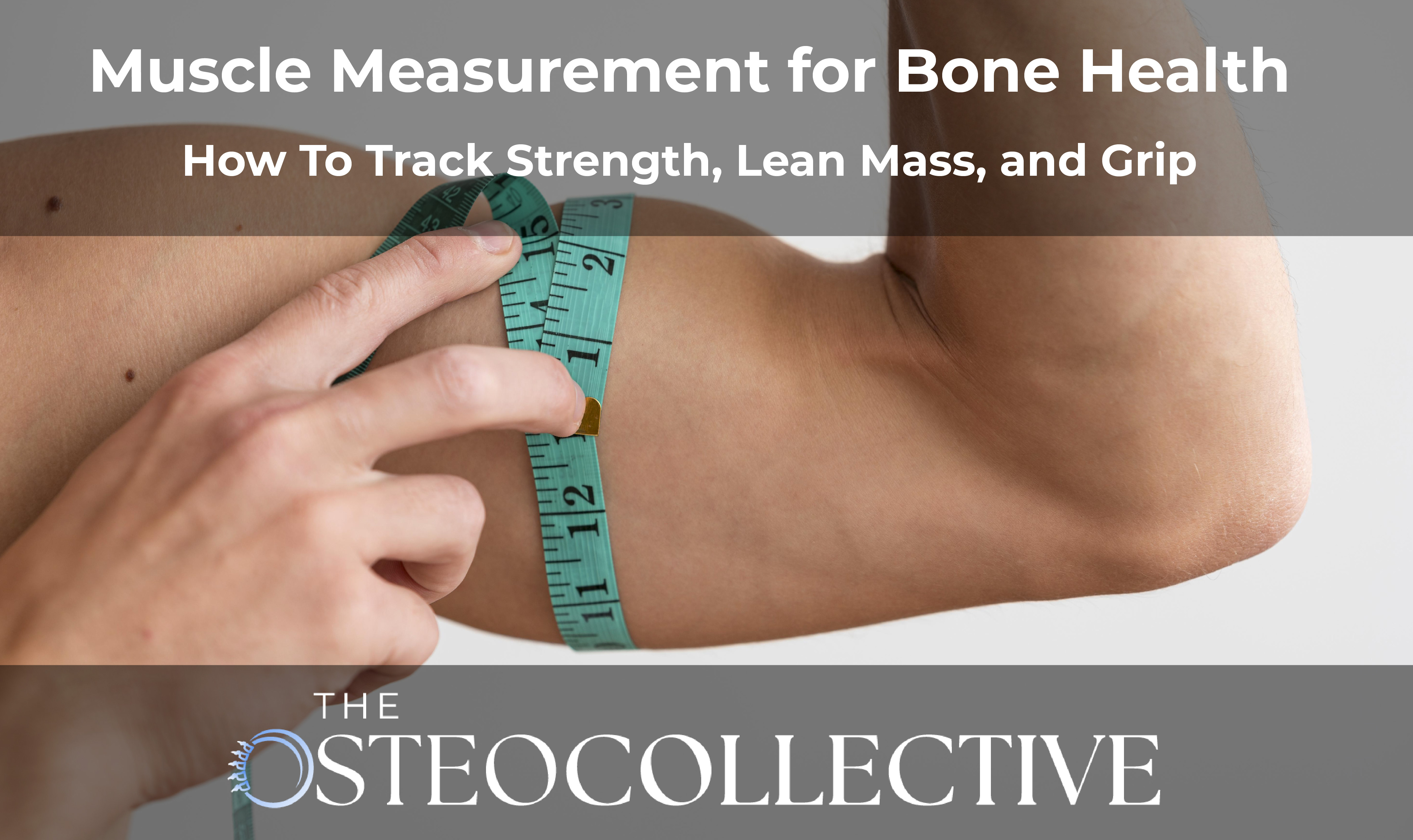
Muscle Measurement for Bone Health: How to Track Strength, Lean Mass, and Grip at Home

live better, longer

January 16, 2026
Muscle protects bone. Learn how to measure lean mass and grip strength with DEXA/BIA, standardize readings, and use the data to cut fall and fracture risk.

We’re finally good at measuring bone (DEXA, TBS, REMS)… but what about muscle? For most people, muscle mass has never been measured—even though muscle and bone are inseparable partners. Stronger muscle → better balance, higher forces on bone → more remodeling stimulus → fewer falls and fractures. This guide explains why muscle testing matters, what to use (at home vs. clinic), how to do it correctly, and how to track it alongside your bone plan.

Why muscle testing is overdue

  • Muscle drives bone. Resistance and impact training deliver the mechanical signals that tell osteoblasts to build. If muscle is shrinking (sarcopenia), bones get fewer high-quality signals.

  • Falls—not just low BMD—cause fractures. Grip strength, leg strength, and power predict falls, independence, and even longevity.

  • What gets measured gets managed. If you only track DEXA every 1–2 years, you miss early wins (or red flags). Muscle metrics can move in weeks to months and keep you motivated.

So why isn’t it standard? Historically, medicine screens when there’s a drug to prescribe. For muscle, the “treatments” are training and nutrition, which aren’t often prescribed in 10-minute visits. That’s changing—so let’s put a simple testing framework in your hands.

The two most useful ways to measure muscle mass

1) DEXA (body composition mode)

Most facilities run DEXA for bone density or body comp, not both in one scan (annoying but common). In body comp mode, DEXA estimates:

  • Lean mass by region (arms, legs, trunk)

  • Fat mass and % body fat

  • Android:gynoid fat distribution

Pros: Well-validated, good regional detail, minimal radiation.
Cons: Appointment-based, not ideal for monthly checks; some sites won’t bundle bone + body comp.

How to use: Aim for a baseline and 6–12 month repeat when you’re changing training/nutrition. Look specifically at appendicular lean mass (ALM)—muscle in arms/legs—because it relates tightly to function and fall risk.

2) Bioelectrical Impedance Analysis (BIA)

BIA sends a tiny current through the body; water conducts, fat resists. Algorithms estimate total body water → fat-free mass → skeletal muscle.

Consumer brands: Withings, Garmin, some InBody home units.
Clinic/fitness brands: InBody (professional models), Tanita, SECA.

Pros: Fast, no radiation, repeatable at home, great for trend tracking.
Cons: Hydration, food, and exercise timing change the reading. Depending on model, BIA can be precise (great for trending) but not perfectly accurate (the absolute number might be off).

Precision vs. accuracy in plain English

  • Accurate = hits the true value (bullseye)

  • Precise = gives the same value each time (tight grouping)
    For training, precision matters most—you’re watching your own trend line, not comparing to your neighbor.

Pro tip: If you can, choose a segmental BIA (separate arms/legs/trunk). Regional data helps you see if leg muscle (the fracture-protection workhorse) is actually growing.

What about “bone” numbers on BIA?

Some advanced BIA devices report “bone mineral content.” Treat this as experimental. It’s interesting, but not a substitute for DEXA/TBS/REMS. Until we have stronger validation against gold standards, use BIA for muscle, fat, and water—not for clinical bone decisions.

Don’t forget the strongest functional predictor: Grip strength

Grip strength (via a hand dynamometer) tracks all-cause mortality and disability risk nearly as well as VO₂ max. Many clinics pair BIA with a grip device; inexpensive handheld dynamometers also work at home.

Targets (broadly):

  • Women: aim to move toward >20–24 kg (individualized by age/size)

  • Men: aim to move toward >30–36 kg

Don’t obsess over a single reading; track trend every 2–4 weeks.

A simple, practical testing protocol (you can start this week)

Step 1 — Baseline

  • DEXA (body comp) if accessible, or BIA at home/clinic.

  • Record: Total body mass, skeletal muscle mass (or fat-free mass), appendicular lean mass, and % body fat. Add grip strength (best of 3 per hand).

Step 2 — Standardize your BIA routine

To improve precision, measure under the same conditions:

  • Morning, after using the restroom

  • Before food/caffeine/exercise

  • Similar hydration day-to-day (don’t chug 24 oz right before)

  • Bare feet, same device, same placement

Log date/time, device, and conditions in your notes.

Step 3 — Track monthly; confirm with DEXA

  • BIA & grip: every 2–4 weeks

  • DEXA body comp: every 6–12 months (when changing programs)

  • Watch for leg-dominant lean mass and grip strength trending up, even if scale weight is flat.

Step 4 — Pair your numbers with the right actions

  • If muscle is flat/down:


    • Increase total protein to ≥1.0–1.2 g/kg/day (many thrive at 1.2–1.6 g/kg/day), distribute 30–40 g per meal, front-load breakfast to kickstart training readiness.

    • Progressive resistance 3–4×/week; emphasize legs, hips, back, and calf/impact progressions (as tolerated).

    • Consider creatine monohydrate (typ. 3–5 g/day) if approved by your clinician.

  • If fat is up while muscle is flat:


    • Keep protein high, trim ultra-processed carbs/fats, add zone 2 cardio or intervals after strength.

Muscle + bone: how they talk to each other

  • Mechanotransduction: Muscle contractions load bone; bone cells sense strain and adapt. Bigger/stronger muscle can safely produce higher peak forces, which bones interpret as “build me.”

  • Myokines: Contracting muscle releases signaling molecules that influence bone formation (and systemic health).

  • Function first: Muscle improves stability and reaction time, making falls less likely—even before BMD changes.

Translation: If your DEXA hasn’t moved yet but grip strength and leg lean mass are rising, you’re building the capacity to move your bone markers next.

What about hydration and “off” BIA days?

BIA is sensitive to water shifts (menstrual phase, salty meals, hard workouts). If one reading looks odd, don’t panic—check your notes. A 3–7 day average tells the truth better than any single data point.

Recommended cadence (put this in your calendar)

  • Weekly (optional): BIA quick check if you love data

  • Every 2–4 weeks (ideal): BIA + grip strength, under standardized conditions

  • Quarterly: Training block review; adjust programming and protein targets

  • Every 6–12 months: DEXA body comp (and DEXA/REMS/TBS per your bone plan)

Putting it all together (a sample “muscle-forward” morning)

  1. Sleep 7.5–9 hrs (bone + muscle recover here).

  2. Hydrate, then protein-forward breakfast (~30–40 g) to lower stress load and prep you for training.

  3. Sunlight exposure (circadian rhythm), then strength training (lower body emphasis) on 3–4 days/week.

  4. Track: BIA + grip on a consistent schedule. Celebrate progress in strength, reps, range of motion, not just the mirror.

The bottom line

  • Measure muscle because it protects bone—and you can improve it quickly.

  • Use DEXA body comp when you can, BIA for frequent at-home trends, and grip strength as a powerful functional barometer.

Standardize your measurements, pair them with progressive resistance and adequate protein, and watch your fall risk drop and your bone-health ceiling rise.

Medical Disclaimer: This article is for educational purposes only and is not a substitute for personalized medical advice. Always consult your qualified healthcare professional before starting or changing any exercise, nutrition, supplement, or hormone plan, especially if you have osteoporosis, prior fractures, kidney disease, or other medical conditions.

JOIN OUR NEXT 
FREE MASTERCLASS
Click Her To Join Today
Most Recent Blogs