
live better, longer
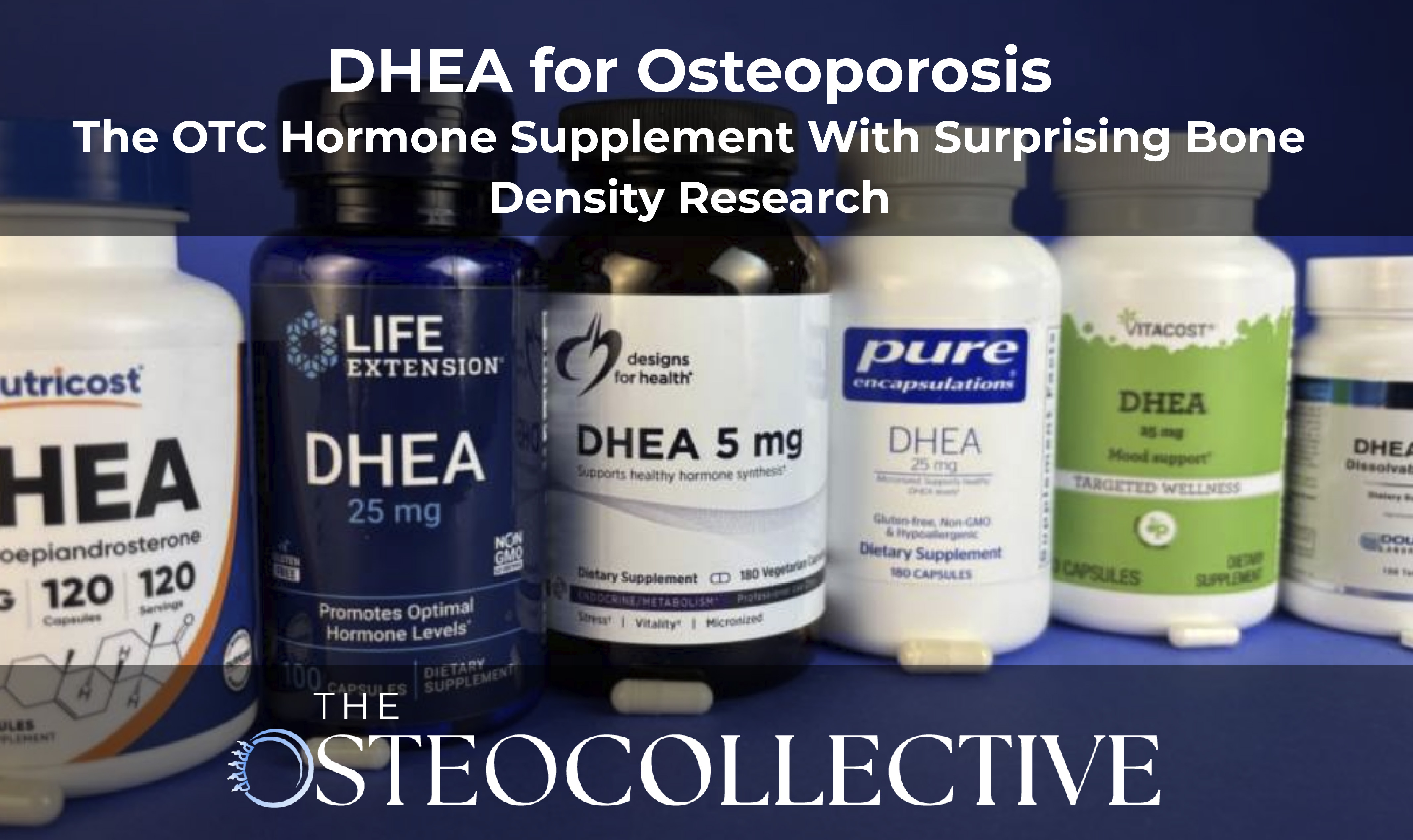
If you’re trying to improve bone density (or at least slow bone loss) without jumping straight to prescriptions, you’ve probably noticed how overwhelming the supplement world can be. Some products are overhyped, some are under-dosed, and many have zero meaningful research behind them. But every once in a while, a widely available over-the-counter option shows up with data that’s actually worth paying attention to.
One of those is DHEA—short for dehydroepiandrosterone. It’s a steroid hormone made primarily by the adrenal glands (the small glands on top of your kidneys). DHEA also acts as a “precursor hormone,” meaning your body can convert it into other hormones—most notably testosterone and estrogen. And because DHEA tends to decline with age, it’s been used in health optimization circles for years for mood, cognition, metabolic support, immune function—and yes, bone health.
What makes DHEA interesting for osteoporosis is that multiple studies and reviews suggest a consistent signal: bone mineral density (BMD) can improve, especially in women. That doesn’t automatically mean it’s right for everyone, but the research is strong enough that it deserves a real look instead of a quick scroll past the supplement aisle.
Bone loss after menopause is heavily driven by changes in hormones—especially estrogen—and by increased activity of the cells that break bone down (osteoclasts). One of the proposed mechanisms for DHEA is that it may influence signaling through estrogen pathways and help reduce bone resorption (breakdown).
From a physiology standpoint, the “why” matters because it gives context to what the studies show. DHEA isn’t just a random vitamin. It’s closer to a lever that can shift the environment your bones are living in—particularly for postmenopausal women.
Before getting into individual trials, it’s worth noting that a 2020 review reported a pretty eye-catching pattern: across the studies reviewed, older women (roughly 50–80 years old) consistently showed increased BMD with DHEA supplementation. That doesn’t mean every study is perfect, but it suggests we’re not looking at a one-off fluke.
A 2019 meta-analysis adds to that signal, reporting improvements in hip BMD in women (over placebo), but not in men. It also noted increases in IGF-1 in women, again not men—hinting that the physiologic response may be meaningfully different by sex.
That’s the high-level overview. Now let’s look at the most referenced human trials.
In one well-known study, participants were given:
They were compared to a group receiving vitamin D and calcium (without DHEA). The standout result: in women, spine BMD increased—about 1.7% after one year and 3.6% by year two. The study also reported increases in hormones like testosterone, estradiol, and IGF-1 in the DHEA group.
The big takeaway here is not that DHEA is “magic,” but that it appears to create a more bone-supportive hormonal environment—at least in this population and under these conditions.
This trial included 225 participants, used 50 mg DHEA for 12 months, and measured changes in:
The results again showed a consistent signal in women:
In men, results were less impressive—often trending in a positive direction, but not reliably reaching statistical significance.
A smaller randomized trial in men used a much higher dose:
They reported improvements in:
Interestingly, even with the higher dose, the study did not show large changes in measured sex hormones, but still reported bone density improvement—and emphasized safety outcomes (including PSA monitoring).
This doesn’t prove DHEA is the “answer” for men, but it does suggest dosing and physiology may matter, and that men may require a different approach than women to see the same bone response.
If you zoom out, the pattern looks like this: DHEA shows the clearest BMD benefit in postmenopausal women, particularly at the spine. In men, it’s more mixed unless doses are higher—and higher dosing brings its own tradeoffs.
It’s also important to remember that DHEA in the studies is rarely used in isolation from lifestyle fundamentals. Bone density improvements are always easier to interpret when people are also doing the basics: resistance training, adequate protein, vitamin D sufficiency, calcium adequacy (diet-first), and addressing the big drivers like inflammation, sleep, and stress load.
DHEA may be a useful lever—especially for the person whose bone loss is being driven by a hormonal environment that is clearly shifting against them. But it’s not a substitute for a full bone-building strategy.

Even though DHEA is over-the-counter, it doesn’t mean it’s “nothing.” Clinically, the most common issue is that DHEA can push harder on the androgen pathway in some people, particularly women.
This is one of the main reasons many clinicians are cautious about jumping straight to the higher study doses (like 50 mg in women), even though those are the doses associated with stronger BMD findings.
There isn’t one “perfect” brand, but if someone is going to use DHEA, quality control becomes the non-negotiable part. Since hormone-active supplements can vary dramatically in purity and dosing accuracy, the goal is to reduce the chances of getting something under-dosed, over-dosed, or contaminated.
DHEA is one of those rare OTC supplements where the research actually gives it real credibility—especially for postmenopausal women and especially for spine BMD. The consistency across reviews, meta-analyses, and multiple randomized trials is hard to ignore.
That said, the dosing used in studies is often higher than what many people tolerate comfortably, and side effects—especially androgenic effects—can be a dealbreaker for some. So the “best” way to think about DHEA isn’t as a universal recommendation, but as a tool that may fit the right person at the right time, ideally with some basic lab monitoring and a larger plan behind it.
Your Blueprint for Lasting Bone Health and Longevity

.svg)
.svg)
.svg)
.svg)


Join us LIVE October 15th, 2026 at 3:00pm EST to Learn Dr. Doug's proven framework for Osteoporosis Reversal for FREE. Yes! Reversing Osteoporosis is possible and has happened for hundreds of Dr. Doug's patients.
If you have been blind-sided, feel stuck, confused, and exhausted with your diagnosis, this Masterclass is for you!

.svg)

.svg)
