
live better, longer
If you are trying to reverse osteoporosis without drugs, you have probably heard one message over and over: lift heavy. Resistance training is great, and I agree with that. But here’s the problem I see every week in our clinic, our community, and our YouTube comments.
A lot of people with osteoporosis have never lifted weights. Or they cannot lift heavy right now. They may have arthritis, spine changes, old fractures, or just fear of getting hurt. And honestly, that makes sense. When you already feel fragile, the idea of heavy weights can feel like a bad plan.
But muscle still matters. Muscle supports balance. Muscle supports your joints. Muscle supports movement. And muscle protects bone in more ways than most people realize. If you want strong bones, you need strong muscle.
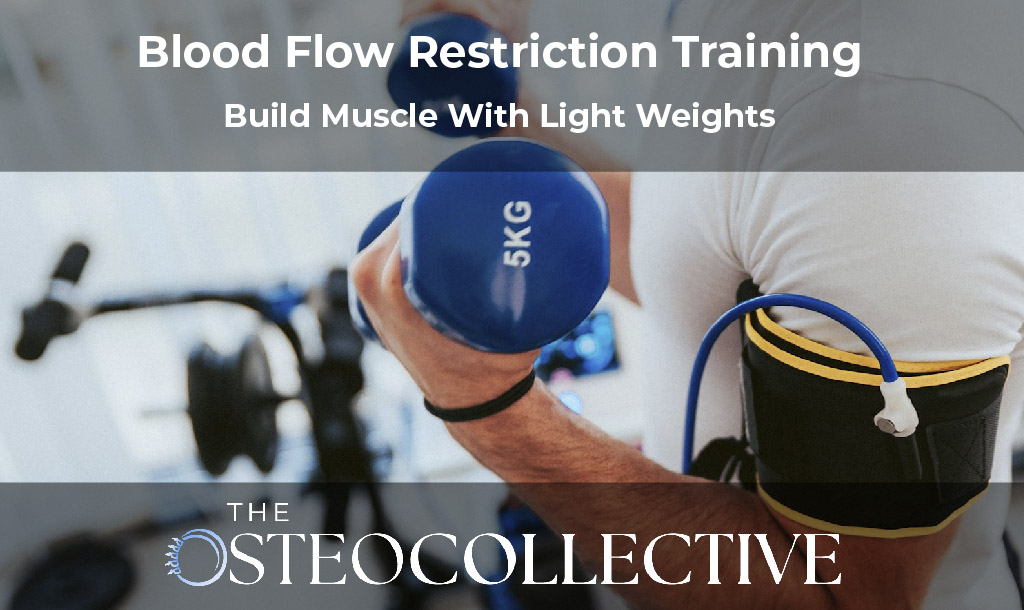
That is why I want to talk about blood flow restriction training, also called BFR. It can help you build muscle and strength using light weights. For the right person, it can be a powerful tool.
Blood flow restriction training is simple in concept. You place a cuff or band high on the arm or high on the leg. You inflate it or tighten it to reduce blood flow out of the limb, while still allowing blood flow into the limb.
That creates a strong training signal, even when the weight is light.
This matters because heavy weight is not always safe or realistic in the beginning. But BFR can help you train in a way that feels “hard” to the muscle without loading the joints like heavy lifting does.
This is why BFR shows up in physical therapy, sports rehab, and now increasingly in the bone health space.
Osteoporosis is not just a bone problem. It is often a muscle problem too. Many people lose muscle before they ever lose bone. And once muscle drops, falls become more likely.
Here is the core idea: if BFR helps you build muscle safely, it can help lower fracture risk. Not because it magically “fixes” bone, but because it helps you build the system that protects bone.
Also, bone responds to load. Muscle creates load. Stronger muscle can create more force across bone over time.
So BFR becomes a useful bridge for people who are not ready for heavy training, but still need a path forward.
Let me be clear. BFR is not the final destination. In most people, the best plan still includes:
BFR is a tool. It can get you moving. It can help you build confidence. It can help you build muscle. And it can help you progress to heavier training later.
For some people, BFR may also stay in the plan long term as a joint-friendly option.
When you restrict blood flow, your body thinks the muscle is working harder than it is. The muscle fatigues faster. That triggers signals that support growth and strength.
The big win is that you can do that with light loads.
This is why BFR often uses very low weight. Sometimes it is only bodyweight.
And for people who are deconditioned, consistency is everything.
BFR is not for everyone, but it is especially useful for people who want muscle benefit while reducing joint stress.
BFR can be a great tool for:
If you are in one of these categories, BFR may be worth talking to your provider about.
This is not fear-mongering. This is just risk management.
If you have certain conditions, BFR may not be appropriate. This is why you need to talk to a qualified provider first.
If you are unsure, assume you need medical clearance first.
The biggest mistake people make with BFR is using random bands with random tightness.
Some people use knee wraps, straps, or cheap bands with no way to measure pressure. That can become unsafe fast.
Good BFR is controlled. You want a system that helps you apply consistent pressure, and you want to avoid going too tight.
That is why I like systems that are made for BFR, not random DIY straps.
BFR is not about ego. It is about signal.
You can get a strong signal with light weights, but you have to do it correctly. The typical approach is higher reps, short rest, and a controlled tightness.
That last line matters. If your limb goes numb or changes color in a concerning way, that is not “normal.” That is your body telling you to stop.
Here is where I want to set honest expectations.
BFR is primarily a muscle tool. The direct bone benefit is not as clear as heavy resistance plus impact.
But osteoporosis is a fracture risk problem. And fracture risk is strongly tied to:
So BFR may reduce fracture risk indirectly by improving strength and stability.
It can also help people train who otherwise would not train. And that is a huge win.
If BFR is the thing that gets you consistent, then it may be one of the most important tools in your plan.
You will see many BFR options online. Some are high-end cuffs. Some are bands. Some are cheap straps.
I care about two things:
If it is too annoying, you will not use it. If it is too random, you may overdo it.
A brand you may hear about in this space is Kaatsu. It is one of the better-known systems that focuses on controlled pressure and structured use. There are others too, but the main point is: avoid sloppy, random tightening.
If I’m building a plan for someone with osteoporosis who is not ready for heavy resistance training, I would use BFR like a bridge.
Here is what that looks like in the real world.
BFR does not replace impact. But it can support the muscle foundation that makes impact safer.
For many people, yes, when done correctly. But it is not something to guess on. Use proper equipment, follow guidance, and get clearance if you have risk factors.
It may help indirectly by improving muscle and reducing falls. But if your goal is bone building, you still need impact or simulated impact plus resistance training.
Most people do well with 2–3 sessions per week. More is not always better, especially if recovery is poor.
Yes, and that is one reason I like it. But do it safely.
If you have osteoporosis, you need a plan you can actually follow.
Some people jump straight into heavy resistance training. That’s great. Many people cannot.
BFR can be a stepping stone. It can help you build muscle with light weights. It can help your confidence. It can help you stay consistent.
And if you stay consistent long enough, you can build the kind of strength that protects your bones for decades.
If you are trying to connect the dots between training, nutrition, hormones, supplements, labs, and scans, join our free Bone Health Masterclass. We break down the most common mistakes and show you how we build a bone health plan that actually works in real life.
And if you want ongoing support, weekly Q&A, and a community doing this together, consider joining The OsteoCollective. If you still have questions after watching or reading, that is exactly where you should bring them.
This content is for educational purposes only and is not medical advice. Blood flow restriction training may not be appropriate for everyone, especially individuals with a history of blood clots, cardiovascular disease, uncontrolled high blood pressure, or vascular disorders. Always consult your physician or qualified healthcare provider before beginning BFR training or changing your exercise program.

Your Blueprint for Lasting Bone Health and Longevity

.svg)
.svg)
.svg)
.svg)


Join us LIVE October 29th, 2026 at 300pm EST to Learn Dr. Doug's proven framework for Osteoporosis Reversal for FREE. Yes! Reversing Osteoporosis is possible and has happened for hundreds of Dr. Doug's patients.
If you have been blind-sided, feel stuck, confused, and exhausted with your diagnosis, this Masterclass is for you!

.svg)

.svg)
