
live better, longer
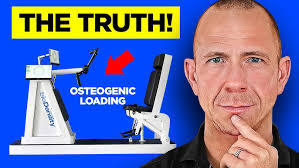
Have you ever wondered what matters most for your spine bone health: resistance training, impact training, or simulated impact like osteogenic loading (BioDensity / OsteoStrong)? This question comes up all the time. And it’s hard to answer without good research.
The good news is we do have a study that helps. It’s not perfect (no study is), but it gives us a real comparison between a high-intensity resistance + impact program and osteogenic loading—with a focus on spine bone mineral density. This is part one of a bigger conversation, but spine is a great place to start because it often changes faster than the hip and gives us a clearer signal early on.
Before we talk outcomes, we have to clean up the language. Bone health gets messy because of brand names, research program names, and commercial programs that come after research.
Here are the key players:
The reason this matters is simple: your doctor might say “do weight-bearing exercise,” but that usually means walking. And walking, in most cases, is not enough to build bone. Even resistance training by itself often slows loss more than it builds new bone. The “missing piece” in many programs is impact—or a safe way to simulate it.
This study looked at men with low bone density and compared three groups over 8 months:
Study details that matter:
This is important because it gives us something we rarely get: a direct comparison between a structured high-intensity program and a machine-based osteogenic loading approach.
HiRIT is not “go lift light weights.” It’s heavy, structured, and specific.
In this study, it used:
That last piece is the impact part. It’s not a casual suggestion. It’s a real stress signal to the skeleton. The problem is that most people cannot safely teach themselves these lifts and this impact drill without coaching. It also requires equipment and a training environment.
So while this is a powerful program, it’s not always realistic for the average person with osteoporosis—especially someone who is deconditioned, fearful of injury, or already has fractures.
BioDensity and OsteoStrong are designed to create high force with minimal movement.
Key points from the transcript:
Osteogenic loading is appealing because it feels controlled and “safer” for many people. There’s no jumping. No barbell on the back. No technical deadlift setup. But it does rely on one thing: you truly pushing close to your max, which sounds simple but is not simple for most people.
This is the headline.
After 8 months:
That looks like HiRIT “wins.” But we need to be careful.
DEXA has a margin of error called LSC (least significant change). In many settings, the LSC is roughly 3–4%. That means if two results are within that range, it can be hard to confidently say one is truly better than the other using DEXA alone.
So the study suggests HiRIT is superior, but the measurement tool limits how confidently we can declare that.
The study also tracked strength and function tests. The general pattern:
That safety signal matters. Many people fear heavy training and impact because they fear fractures. This study suggests that with supervision, these approaches can be safe in the right population.
A major red flag in the transcript is that the control group’s spine BMD went up by almost a percent. In older adults, we usually expect stability at best, or slow decline, not improvement.
When a control group improves, it raises questions like:
It doesn’t destroy the study, but it means we should not overclaim.
This is a big one.
BioDensity and OsteoStrong typically recommend once per week, based on the idea that the stimulus requires 5–7 days to recover and adapt. This study used twice per week.
Could that blunt adaptation? Possibly.
If the body needs time to respond to a high-force stimulus, repeating it too soon might:
We do not have enough data to say for sure, but it’s an important variable.
This is a practical issue that doesn’t show up clearly in data tables.
Osteogenic loading depends on positioning and coaching. If someone is slightly out of position, fearful, or just not confident, they may not push anywhere near max. Dr. Doug mentions a learning curve even for trained people.
If effort is not truly high, you may not hit the “growth trigger” needed to stimulate bone.
So if you’re doing osteogenic loading, one of the biggest questions to ask is: am I actually getting coached well enough to produce the stimulus?
Here’s how I translate this study into real-world action.
If you can do it safely, with coaching, it may produce a bigger bone signal than resistance alone. This supports the broader idea that impact matters for building bone.
It showed improvement too. And for many people, it’s more realistic and less intimidating than barbells and jump drills.
Even if you do osteogenic loading, you still need:
And if you do HiRIT, you still need to consider what’s realistic long-term and what you can do safely.
DEXA can miss changes or blur differences. We need:
This transcript also mentions part two will cover more hip outcomes and other imaging approaches, which is where a lot of the “quality” story becomes more clear.
If you’re trying to decide what’s best for your bones—HiRIT, osteogenic loading, vibration, gym lifting, home training—this is exactly why we run our free bone health masterclass. It’s designed to help you avoid the most common mistakes and build a plan that matches your body, your risk level, and your lifestyle.
And if you want ongoing support, coaching, and a community that lives in this world every day, that’s what the OsteoCollective is for. You don’t have to guess alone.
This study suggests high-intensity resistance plus impact may produce a larger spine improvement than osteogenic loading, but DEXA measurement limits certainty. Both improved spine BMD.
Impact (or simulated impact) appears to be a key signal for building bone. Resistance training alone often slows loss but doesn’t consistently build bone in research.
In this study, both HiRIT and BioDensity were supervised and had no fractures reported. Safety depends on coaching, starting point, and proper progression.
Most commercial programs recommend once weekly, but this study used twice weekly. We need more research to know the best frequency.
Not easily. Deadlifts, back squats, overhead press, and impact drills require coaching and equipment. Many people need a safer, scaled version.
This content is for educational purposes only and is not medical advice. It is not intended to diagnose, treat, cure, or prevent any disease. Always consult a licensed healthcare professional before starting or changing supplements, medications, or an exercise program—especially if you have osteoporosis, fractures, or medical conditions that affect balance, strength, or fall risk.

Your Blueprint for Lasting Bone Health and Longevity

.svg)
.svg)
.svg)
.svg)


Join us LIVE October 22nd, 2026 at 12:00pm EST to Learn Dr. Doug's proven framework for Osteoporosis Reversal for FREE. Yes! Reversing Osteoporosis is possible and has happened for hundreds of Dr. Doug's patients.
If you have been blind-sided, feel stuck, confused, and exhausted with your diagnosis, this Masterclass is for you!

.svg)

.svg)
