
live better, longer
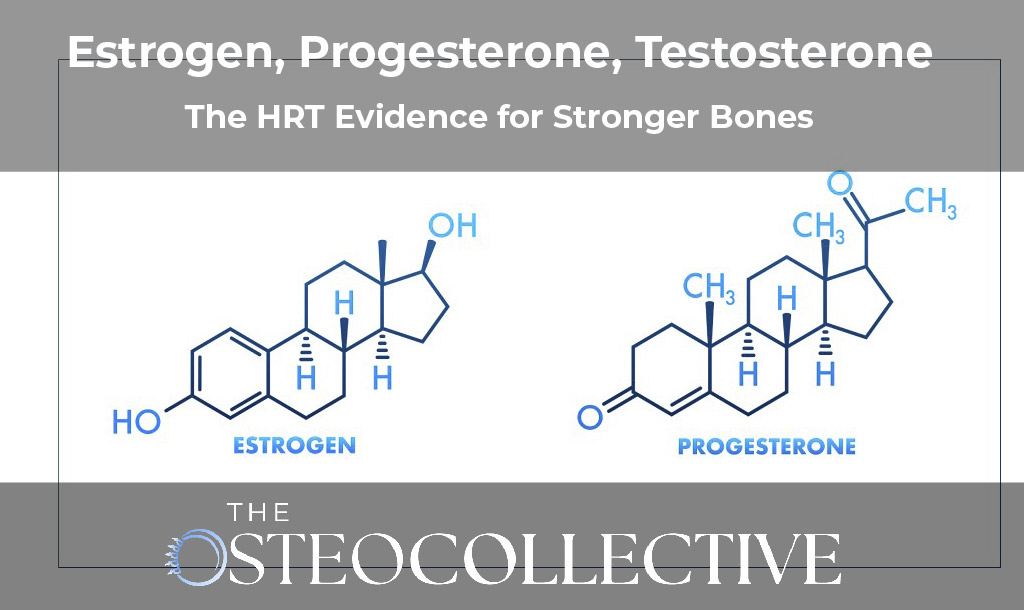
Hormones can be one of the strongest tools we have for bone health. That statement makes some people nervous. I get it. Hormones come with fear, bad headlines, and a lot of mixed opinions. But when you look at the bone research, there is a big story sitting right in front of us: HRT can protect bone in a powerful way.
Today I want to review the three main sex hormones in women: estrogen, progesterone, and testosterone. I also want to show you why the evidence for hormones and bone is stronger than most people realize—especially estradiol. And yes, we’ll also talk about common concerns, because you can’t make good decisions without knowing the risks and the benefits.
This is not “everyone should take hormones.” It’s not that simple. It’s about having a real conversation, using real data, and not ignoring one of the biggest levers we have.
Estrogen has a long list of fears attached to it:
That is a lot.
But here is the key point: estradiol is FDA approved for osteoporosis support. That alone should tell you this is not a fringe idea. Bone is one of the clearest use cases for estradiol in women’s health.
One reason doctors miss this is that many providers who focus on hormones do not spend much time inside osteoporosis research. If you read bone literature, you see a mountain of evidence that estrogen is a major bone hormone.
When you look at the studies, you see a pattern: HRT improves bone mineral density. Over and over.
Dr. Doug describes reviewing a large meta-analysis and seeing just how many studies were included that used HRT specifically for bone outcomes. The point is not to memorize every paper. The point is this: the evidence is not thin. It’s broad.
One of the most interesting examples is a bone drug study from 1998 (Fosamax/alendronate). For whatever reason, the study compared the drug to HRT using different forms. And what they found was clear: HRT was more powerful than the drug in that study.
Even more interesting: the study had a U.S. cohort and a European cohort, and the European cohort performed best. Why?
This matters because it hints at something we see again and again: how hormones are dosed can change the bone result.
Here is a hard truth: low-dose HRT does not always protect bone enough.
Different tissues have different “receptor needs.” Bone may need a certain level of estradiol before you get a strong result. Dr. Doug notes a threshold range discussed in the literature around 60–80 pg/mL. Many standard low-dose plans may not get women to that range.
A dose-response study Dr. Doug mentions is especially important:
This connects to a common mistake: many women are prescribed BiEst (estradiol + estriol) and are told it will help bone. But estriol is not the bone-protective hormone. Estradiol is.
Progesterone often gets treated like the sidekick. “You only need it because you’re on estrogen.” That is incomplete.
Progesterone has potential benefits for:
The issue is research design. Progesterone is often studied with estrogen, not alone, so it’s harder to isolate its true impact.
This is a major point in Dr. Doug’s approach:
Also, progesterone is not optional if you have a uterus and you are using estrogen. Unopposed estrogen can thicken the uterine lining (endometrium). That can become dangerous. Progesterone is part of protection.
This part surprises many people.
Older bone-health hormone protocols often used cyclic progesterone. That means you use progesterone in a rhythm, not flat every single day. In some cases, this can lead to breakthrough bleeding or even a full bleed, depending on the plan and doses.
Dr. Doug points out something important: many clinicians training in hormones over the last 10–15 years were not taught much about rhythmic dosing. It faded after the WHI era. The mindset became:
Yes, we want to catch real pathology. But not all bleeding is pathology. And the bigger message is this: static dosing may not be as strong for bone as physiologic-style dosing in many of the older studies.
We still don’t know who needs more and who does fine on static dosing. But the fact that rhythmic dosing shows up repeatedly in bone studies is worth paying attention to.
Now let’s talk about the androgen side. These are hormones that tend to be more “building” (anabolic).
For women, that usually means:
DHEA is a common tool because:
Dr. Doug points out a key real-world issue: many women can still make testosterone after menopause, but a lot of that depends on adrenal function. High stress → adrenal dysfunction → low DHEA → low testosterone. That pattern is common in osteoporosis.
So DHEA can be a lever that supports the whole hormone picture.
Testosterone is a bigger conversation.
Major organizations have stated testosterone should only be used for hypoactive sexual desire disorder and not for other uses, largely due to risk concerns and lack of FDA approval for broader indications. That makes prescribing harder, especially in telehealth where regulation is tighter.
Still, in practice, many women and men do well when testosterone is prescribed responsibly.
Key points Dr. Doug highlights:
In men, a meta-analysis of over 1,100 men showed testosterone can increase BMD at 6 months and often at 12 months. But not all studies show benefit. One issue: many studies raise testosterone only slightly (example: 250 → 300), which is still low.
That is a big deal. If you don’t raise the level enough, you can’t expect strong outcomes.
Doctors fear androgen side effects (acne, hair growth, hair loss, oily skin). Those can happen. But Dr. Doug also points to evidence suggesting testosterone may be protective for breast cancer and does not clearly raise plaque risk or event risk in a way people fear.
A key clinical point: low testosterone is itself a risk factor for heart disease in men. So the conversation is not “testosterone = risk.” It’s more complex than that.
Here’s what I want you to take away:
The biggest mistake I see is people trying to “self-prescribe” a hormone plan off of fear, or off of one lab marker, or off of one influencer. That rarely goes well.
The right move is getting guidance from someone who understands both sides of the equation:
If you want to go deeper on hormones and bone, we run a free Masterclass where we explain how we think about labs, dosing, form, rhythm, and risk vs benefit.
And if you still feel stuck trying to put everything together—exercise, nutrition, supplements, hormones, testing—our free Bone Health Masterclass is a great starting point too.
This content is for educational purposes only and is not medical advice. It is not intended to diagnose, treat, cure, or prevent any disease. Always consult a qualified healthcare professional before starting, stopping, or changing any medication, supplement, or hormone plan, especially if you have a history of cancer, blood clots, cardiovascular disease, or osteoporosis-related fractures.

Your Blueprint for Lasting Bone Health and Longevity

.svg)
.svg)
.svg)
.svg)


Join us LIVE October 22nd, 2026 at 12:00pm EST to Learn Dr. Doug's proven framework for Osteoporosis Reversal for FREE. Yes! Reversing Osteoporosis is possible and has happened for hundreds of Dr. Doug's patients.
If you have been blind-sided, feel stuck, confused, and exhausted with your diagnosis, this Masterclass is for you!

.svg)

.svg)
