
live better, longer
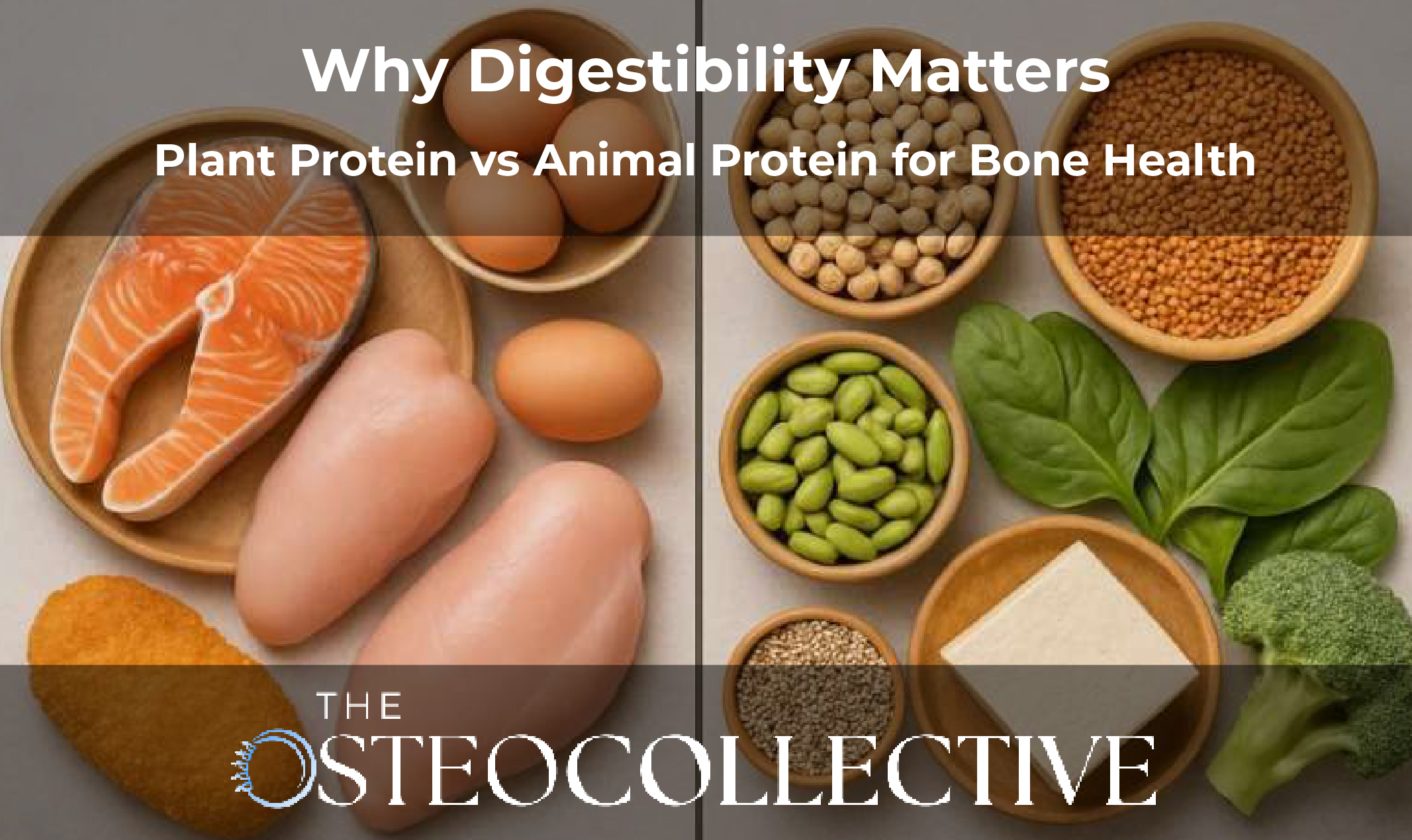
Protein is one of the most important nutrients for bone health.
But here is where the conversation gets confusing: not all protein sources act the same in the body.
Many people assume that if a food label says “20 grams of protein,” that means the body gets 20 grams of usable protein. Unfortunately, that is not always true.
This matters for everyone, but it matters even more if you are trying to improve osteoporosis, build muscle, preserve strength, and reduce fracture risk.
Plant proteins can absolutely be part of a healthy diet. But when it comes to building muscle and supporting bone, animal proteins are generally more bioavailable, more digestible, and more complete.
That does not mean you have to eat animal protein.
But if you rely heavily on plant protein, you need to understand what you are working with so you can make smarter choices.
Let’s break this down.
Bone is not just calcium.
Bone is living tissue. It has a mineral component, but it also has a protein matrix. Collagen, amino acids, muscle mass, hormones, and mechanical loading all play a role in how strong your bones become.
Protein matters because it supports:
Muscle and bone are deeply connected. If you are under-muscled, you are more likely to have poor bone quality, poor balance, and higher fracture risk.
So when we talk about osteoporosis, we have to talk about protein.
And not just total grams. We have to talk about usable protein.
Bioavailability means how much of a nutrient your body can absorb and actually use.
For protein, bioavailability depends on several things:
A protein source can look good on paper but still be less useful in real life if your body cannot digest it well.
This is one of the big problems with many plant proteins.
Animal proteins tend to be more complete and easier to digest.
They usually contain all essential amino acids in amounts that are closer to what humans need.
Examples include:
Plant proteins can still provide amino acids, but they often come with limitations.
Those limitations include:
Again, this does not mean plants are “bad.”
It means plant protein requires more strategy.
Fiber has many benefits.
It can support gut health, blood sugar regulation, short-chain fatty acid production, bowel regularity, and metabolic health.
But when it comes to protein digestion, fiber can sometimes get in the way.
Some plant proteins are bound up in fibrous structures that humans do not digest well. If the protein is trapped inside that structure, your body may not be able to fully break it down and absorb the amino acids.
So even if a plant food contains protein, the amount you actually use may be much lower.
This is one reason protein “on the label” is not the same as protein “in your body.”
Antinutrients are naturally occurring compounds found in plants.
They are not necessarily dangerous. They are part of the plant’s natural defense system. But they can interfere with digestion and nutrient absorption.
In the context of protein, certain antinutrients can make it harder to break down protein into usable amino acids.
Three important antinutrients to understand are:
Let’s look at each one.
Trypsin is an enzyme that helps break down protein.
Trypsin inhibitors interfere with that process.
If trypsin is blocked, protein is not broken down as efficiently. That means fewer amino acids may be available for absorption and use.
Trypsin inhibitors are especially high in soybeans.
They can also be found in:
Soy is a big one because many people using plant-based diets rely on soy as a major protein source.
Soy can have a decent amino acid profile compared with many other plant proteins. But if digestion is impaired by trypsin inhibitors, the real-world benefit may be lower.
Yes, to some extent.
Trypsin inhibitors can be reduced through:
You may not remove them completely, but preparation can improve digestibility.
This is why traditional preparation methods matter.
Tannins are compounds that can bind to proteins and make them harder to digest.
Many people think of tannins in wine, but tannins are also found in plant foods.
Tannins can bind protein and reduce amino acid digestibility. This can lower protein quality, especially when someone relies heavily on tannin-rich plant foods for protein.
Some studies suggest tannins can significantly reduce protein digestibility, especially in grains and legumes.
Not as easily.
Tannins tend to be more heat resistant than trypsin inhibitors. Cooking may not fully solve the problem.
Other methods, such as soaking, dehulling, and fermentation, may help reduce tannin burden.
Phytates, also called phytic acid, are another important antinutrient.
Phytates bind minerals and other nutrients. They can also interfere with protein digestion by binding cofactors and digestive enzymes.
This matters for bone health because phytates may interfere with minerals like:
And those minerals matter for bone, hormones, energy, and overall health.
Phytates can reduce amino acid digestibility and mineral availability.
Yes, but not always through simple cooking.
Phytates are fairly heat stable. Better strategies may include:
Again, preparation matters.
To compare protein quality, researchers use scoring systems.
Two important ones are:
You do not need to memorize these acronyms. But the concept matters.
These scoring systems look at protein quality based on amino acid content and digestibility.
PDCAAS stands for Protein Digestibility-Corrected Amino Acid Score.
It is commonly used, but it can overestimate the quality of some plant proteins.
DIAAS stands for Digestible Indispensable Amino Acid Score.
This is often considered a better tool because it gives more detail about how well essential amino acids are digested and absorbed.
When plant and animal proteins are compared using these systems, animal proteins usually score higher.
Whey, milk, eggs, meat, and other animal proteins tend to have stronger amino acid profiles and higher digestibility.
Plant proteins often score lower, especially when antinutrients and amino acid limitations are considered.
No.
Plant protein is not useless.
But it is often less efficient.
That means if you rely on plants for protein, you may need to:
This is especially important for women in midlife and beyond, because muscle loss and bone loss often happen together.
If your goal is to reverse osteoporosis, preserve muscle, and reduce fracture risk, you cannot afford to under-eat usable protein.
If you eat mostly plant-based, here are some strategies that can help.
Because plant protein is less bioavailable, you may need more total grams to get the same usable amino acids.
Mixing legumes, grains, seeds, and other plant proteins can help improve amino acid balance.
Soaking, sprouting, fermenting, and pressure cooking may improve digestibility and reduce certain antinutrients.
Some plant protein powders may be easier to use than whole plant sources, but quality varies.
Look for options with:
Do not guess. Watch your results.
Track:
If your plan is working, you should see signs of progress.
If you eat animal protein, do not be afraid of it.
High-quality animal protein can be one of the most effective tools for muscle and bone health.
Strong options include:
The goal is not to eat only animal foods. The goal is to make sure you are getting enough high-quality protein to support the body you want to build.
For many people with osteoporosis, this is one of the biggest missing pieces.
Many people avoid animal protein because they are worried about heart disease.
That conversation deserves nuance.
Highly processed meat, poor metabolic health, low fiber intake, smoking, insulin resistance, and inflammation all matter.
But high-quality animal protein in the context of a nutrient-dense diet is not the same as a highly processed diet built around refined foods.
If you are concerned about cardiovascular risk, measure it.
Look at markers like:
Do not make protein decisions based only on fear.
Make them based on data, goals, and your actual health picture.
If you are trying to improve osteoporosis, protein matters.
And protein quality matters.
Animal proteins tend to be more digestible, more bioavailable, and more complete. Plant proteins can still work, but they require more planning because of amino acid limitations, fiber binding, and antinutrients like trypsin inhibitors, tannins, and phytates.
You do not have to avoid plants.
You do need to understand them.
And if you choose a plant-based diet, you need to be more intentional about getting enough usable protein.
If you are struggling to put together the right nutrition plan for bone health, start with the full framework.
That is what we cover in our free Bone Health Masterclass. We walk through the most common myths and mistakes people make when trying to improve bone density, and we help you understand which levers matter most.
Because osteoporosis is not the end. But deciding to reverse it is the beginning.
This content is for educational purposes only and is not medical advice. Nutrition needs vary based on medical history, kidney function, digestive health, medications, activity level, and personal goals. Speak with a qualified healthcare professional before making major dietary changes, especially if you have osteoporosis, kidney disease, autoimmune disease, digestive disorders, or other chronic medical conditions.

Your Blueprint for Lasting Bone Health and Longevity

.svg)
.svg)
.svg)
.svg)


Join us LIVE October 15th, 2026 at 3:00pm EST to Learn Dr. Doug's proven framework for Osteoporosis Reversal for FREE. Yes! Reversing Osteoporosis is possible and has happened for hundreds of Dr. Doug's patients.
If you have been blind-sided, feel stuck, confused, and exhausted with your diagnosis, this Masterclass is for you!

.svg)

.svg)
