
live better, longer
Every few months, a new osteoporosis “breakthrough” hits the internet.
A new pill. A new scan. A new device. A new procedure.
And the big question is always the same:
Is this the secret you’ve been looking for? Is this the magic fix that prevents fractures and makes osteoporosis a non-issue?
Today I want to talk about a new idea that has been getting attention. It’s from a company called Flowbone. Their product is not on the market yet. But it created a lot of curiosity because the claim is bold.
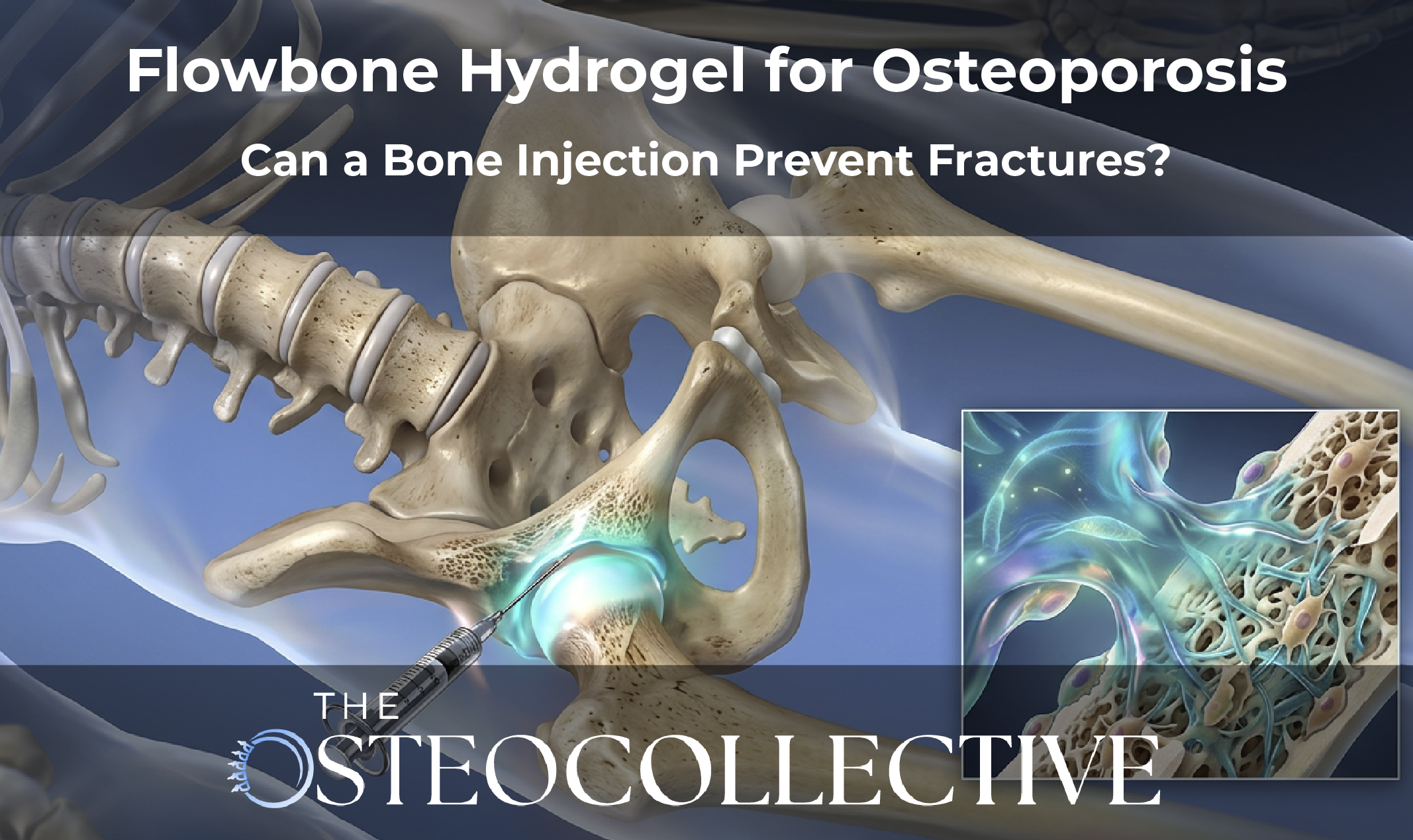
The idea is simple and kind of wild: inject a gel into weakened bone and make it stronger.
If it works the way people hope, it could become a new tool for fracture prevention. It might even change how we treat high-risk areas like the hip and spine.
But right now, we need to slow down and look at what is actually known.
Because the story sounds amazing. The evidence is early. And osteoporosis is a full-body problem, not just a “one bone” problem.
Let’s break this down.
Flowbone is developing a hydrogel that can be injected into weakened bone.
Here is the claim, simplified:
The goal is a fast-acting local treatment that makes bone more fracture resistant.
That is why people are excited.
If you could strengthen the exact area most likely to fracture, quickly, that could be a big deal.
Before I worked in bone health and longevity, I was an orthopedic surgeon. And I used a lot of tools that were designed to improve outcomes after injury or surgery.
When I read about Flowbone, it reminded me of a procedure called subchondroplasty.
Subchondroplasty involved injecting a calcium phosphate “cement” into bone. The goal was to reinforce painful micro-fracture areas that showed up on MRI, often in the knee or lower leg.
It was an interesting idea.
It was also a warning.
Because long-term, it became clear that injected material can stay behind. It may not be absorbed quickly. It may not behave the way the marketing promised. And we do not always understand long-term effects until years later.
Flowbone is different in theory because it claims to work with the body’s natural bone metabolism rather than leaving cement behind.
That is the appealing part.
But right now, it is still early.
At this point, the research that is public is mostly animal research.
That does not make it useless. Animal studies are often the first step. But it does mean we are far away from knowing how it performs in humans.
In a rat model, the hydrogel showed strong changes when measured by micro-CT. The reported results included:
That sounds impressive.
But here is the problem.
We are not large rats.
Rodent bone metabolism is faster than human bone metabolism. That changes timelines. It changes healing speed. It changes remodeling. It changes how quickly a product appears to “work” and how quickly it wears off.
So an 8-week effect in a rat does not automatically mean an 8-week effect in a human.
It might mean months. It might mean longer. Or it might mean something totally different.
That is why we need human trials.
This is where we stay grounded.
Flowbone is promising, but we do not have the answers to the questions that matter most.
Until we have those answers, we cannot call this a solution.
We can only call it a possibility.
This is a key point.
Osteoporosis is a systemic disease. It reflects the state of the whole skeleton, plus hormones, nutrition, inflammation, muscle, and lifestyle.
So local solutions often have limited value unless they are used in a very specific way.
That does not mean local tools are useless.
It just means they may fit best in one of these situations:
That is where I can see Flowbone potentially fitting in the future.
If the hydrogel truly stimulates local bone formation and does not leave foreign material behind, there are several use cases that could be huge.
Those are real possibilities.
But they are still possibilities.
Even if Flowbone becomes real and works well, it does not solve the full osteoporosis problem.
Because the core issue remains:
Why was the bone weak in the first place?
If you do a local procedure but the person still has:
Then fractures can still happen elsewhere.
So even if local tools become part of fracture prevention, lifestyle and physiology still matter.
If Flowbone becomes available, I would not see it as a replacement for bone health plans.
I would see it as a tool for a specific group.
That is the “right lane” for procedures like this.
It is not the “everyone with osteopenia” lane.
Right now, the best plan is still the plan we already know works.
If you want to reduce fracture risk, focus on what you can control today:
That approach can be done indefinitely.
And the benefit is bigger than bones. It improves health span.
Flowbone might become a helpful “extra” tool one day.
But the goal is to never need it in the first place.
If this topic matters to you because you feel like you do not have a clear long-term plan, I would encourage you to join our free Bone Health Masterclass. We walk through the biggest mistakes we see and the most effective levers to pull first. There is also live Q&A so you can ask questions directly.
And if you want deeper support, coaching, and community, that is what The OsteoCollective is for.
Because osteoporosis is not the end. But deciding to reverse it is the beginning.
No. Based on what’s publicly discussed, it is not on the market yet. It appears to be in early development with early research.
It sounds different. Traditional cement approaches aim to stabilize with material that can remain in the bone. Flowbone’s claim is that it stimulates real bone formation and does not leave foreign material behind. That needs human data.
Possibly in the future, if human trials show meaningful strengthening in the femoral neck or trochanter region. We are not there yet.
Bone metabolism is different. Rodents remodel bone faster. A result in 8 weeks for a rat does not automatically mean the same timeline or outcome in humans.
No. The best move is to act now with proven strategies. New tools may become helpful later, but bone health is not something to delay.
This content is for educational purposes only and is not medical advice. It is not intended to diagnose, treat, cure, or prevent any disease. Always consult a licensed healthcare professional before making medical decisions, changing medications, starting supplements, or beginning a new exercise program.

Your Blueprint for Lasting Bone Health and Longevity

.svg)
.svg)
.svg)
.svg)


Join us LIVE October 29th, 2026 at 300pm EST to Learn Dr. Doug's proven framework for Osteoporosis Reversal for FREE. Yes! Reversing Osteoporosis is possible and has happened for hundreds of Dr. Doug's patients.
If you have been blind-sided, feel stuck, confused, and exhausted with your diagnosis, this Masterclass is for you!

.svg)

.svg)
