
live better, longer
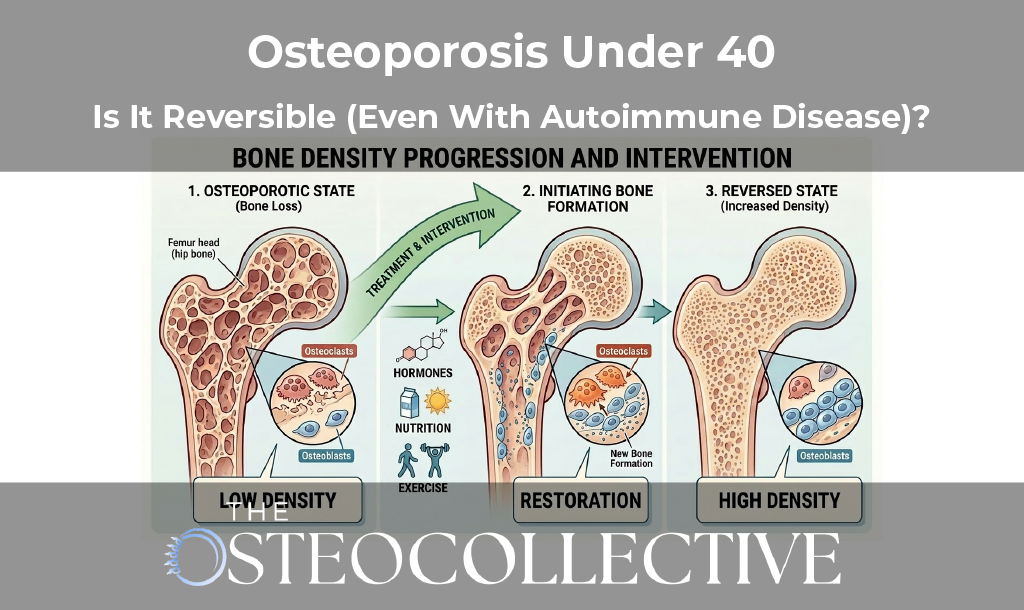
I hear a version of this question all the time:
“I’m 38. I’m female. I have autoimmune disease. I have osteoporosis. Is it reversible under 40? Is this a death sentence?”
First, take a breath.
Osteoporosis is not a death sentence. And yes, osteoporosis can be reversible. But the real answer depends on your situation.
Age matters. Medications matter. Autoimmune disease matters. Your starting bone density matters. Your fracture history matters. And your bone loss trajectory matters.
What I want to do in this post is give you a clear framework so you can stop guessing. Because misunderstandings happen on both sides, and both can hurt you:
So let’s talk about what “reversible” really means. And how we decide what approach makes sense.
The first thing I want to know is not your age.
It’s your trajectory.
Because a T-score is one snapshot in time. Trajectory tells me what direction you’re moving in and how fast.
Here are the questions that matter:
If you don’t know your trajectory, you can’t set real goals. And you will stay stuck in fear.
For many people, especially in complex cases, “reversal” might not be the first goal.
Sometimes the first win is:
Then, once that’s stable, we push for higher goals.
If you are 38 and otherwise healthy, your options are wide open.
You may have years to build strength, restore nutrition, correct hormone issues, and support bone remodeling.
You can often do the full foundation plan:
That is the “big win” of being younger.
But if you have autoimmune disease, we need to add one more layer: what is driving bone loss in your case?
Autoimmune disease can affect bone in several ways:
This is why two people can be the same age, with the same T-score, and have totally different outcomes.
Some medications are known to increase osteoporosis risk, including:
This does not mean “stop your meds.” It means:
We need to understand your full picture and your trade-offs.
Your autoimmune disease may require certain treatments. Our job is to build the best bone strategy around that reality.
Let’s walk through three simple examples. These are not “your exact case.” They are to show how the framework works.
This person has the widest set of options.
Even if a doctor suggests a bisphosphonate right away, this person usually has room to try a serious natural plan first.
That plan includes:
Could this person reverse osteoporosis? Often yes.
But it depends on how severe it is and how fast it is changing.
Now the picture changes.
This person might have:
Can they improve? Sometimes yes. Can they reverse osteoporosis fully? Sometimes, but often not.
In this case, medication may be more important, and lifestyle becomes a “support layer” to reduce falls, improve strength, and reduce fracture risk.
This is a common profile:
This person often has a strong chance to improve with the right plan.
Most people are somewhere between Case 1 and Case 2.
And that is why we don’t do one-size-fits-all.
This matters, especially with social media.
Your neighbor’s plan might work for your neighbor. It might be the wrong plan for you.
So here is the truth:
The goal is not to “win” an argument.
The goal is to prevent fractures and build a body you can rely on.
Here are the biggest factors that push someone toward being a strong candidate for natural reversal:
And here are factors that can make drug therapy more likely to be necessary (at least short-term):
If you have osteoporosis and you stop losing bone, that is still a win.
Not every plan needs to be “reverse everything in 12 months.”
Sometimes the first win is stability.
Then we push.
If you are under 40 and you want a clear next step, here is a simple starting checklist.
If you have autoimmune disease, ask:
Pick a few metrics, not 20.
The biggest stuck points I see are:
You don’t need perfection.
You need the right priorities and consistency.
If you’re trying to figure out where you fall on the “natural vs medication” spectrum, start with our free Bone Health Masterclass. It’s designed to help you stop guessing and avoid the common mistakes.
And if you want deeper support and community, consider The Osteocollective. That’s where we do weekly topic-driven Q&As, share frameworks, and help people build plans that fit real life.
Because osteoporosis isn’t the end. But deciding to reverse it is the beginning.
This content is for educational purposes only and is not medical advice. Osteoporosis and autoimmune conditions require individualized medical care. Do not start, stop, or change medications, supplements, or exercise routines without speaking with a qualified healthcare professional, especially if you have fractures, take prescription medications (including steroids), or have complex medical conditions.

Your Blueprint for Lasting Bone Health and Longevity

.svg)
.svg)
.svg)
.svg)


Join us LIVE October 29th, 2026 at 300pm EST to Learn Dr. Doug's proven framework for Osteoporosis Reversal for FREE. Yes! Reversing Osteoporosis is possible and has happened for hundreds of Dr. Doug's patients.
If you have been blind-sided, feel stuck, confused, and exhausted with your diagnosis, this Masterclass is for you!

.svg)

.svg)
