
live better, longer
One of the most common hormone questions women ask is:
What estradiol level do I need to protect my bones?
The honest answer is: it depends.
But that does not mean we are guessing.
There is a growing body of research that helps us understand how estradiol affects bone metabolism, how different dosing strategies perform, and why one standard dose does not work for every woman.
This matters because estradiol is one of the most powerful natural levers we have for bone health. It helps slow bone loss, supports bone remodeling, and plays an important role in the relationship between menopause, osteoporosis, fracture risk, and long-term health span.
But the conversation often gets oversimplified.
Some women are told they do not need hormone replacement therapy unless they have hot flashes. Others are given a low-dose patch and told that is enough. Some are told not to measure levels at all. Others are told hormones can only prevent bone loss, not improve it.
The research tells a more nuanced story.
Let’s walk through what we know about estradiol dosing, bone density, FSH, patch strength, and the possible role of testosterone.
Estradiol is not just a reproductive hormone.
It plays a major role in:
When estradiol drops during menopause, bone turnover often accelerates. Osteoclast activity increases, which means the body breaks down bone faster than it builds it.
This is why bone loss can be especially rapid in the first several years after menopause.
It is also why women with premature ovarian insufficiency, surgical menopause, or hypothalamic amenorrhea may experience bone loss much earlier in life.
Estradiol is not the only factor in osteoporosis, but it is a major one.
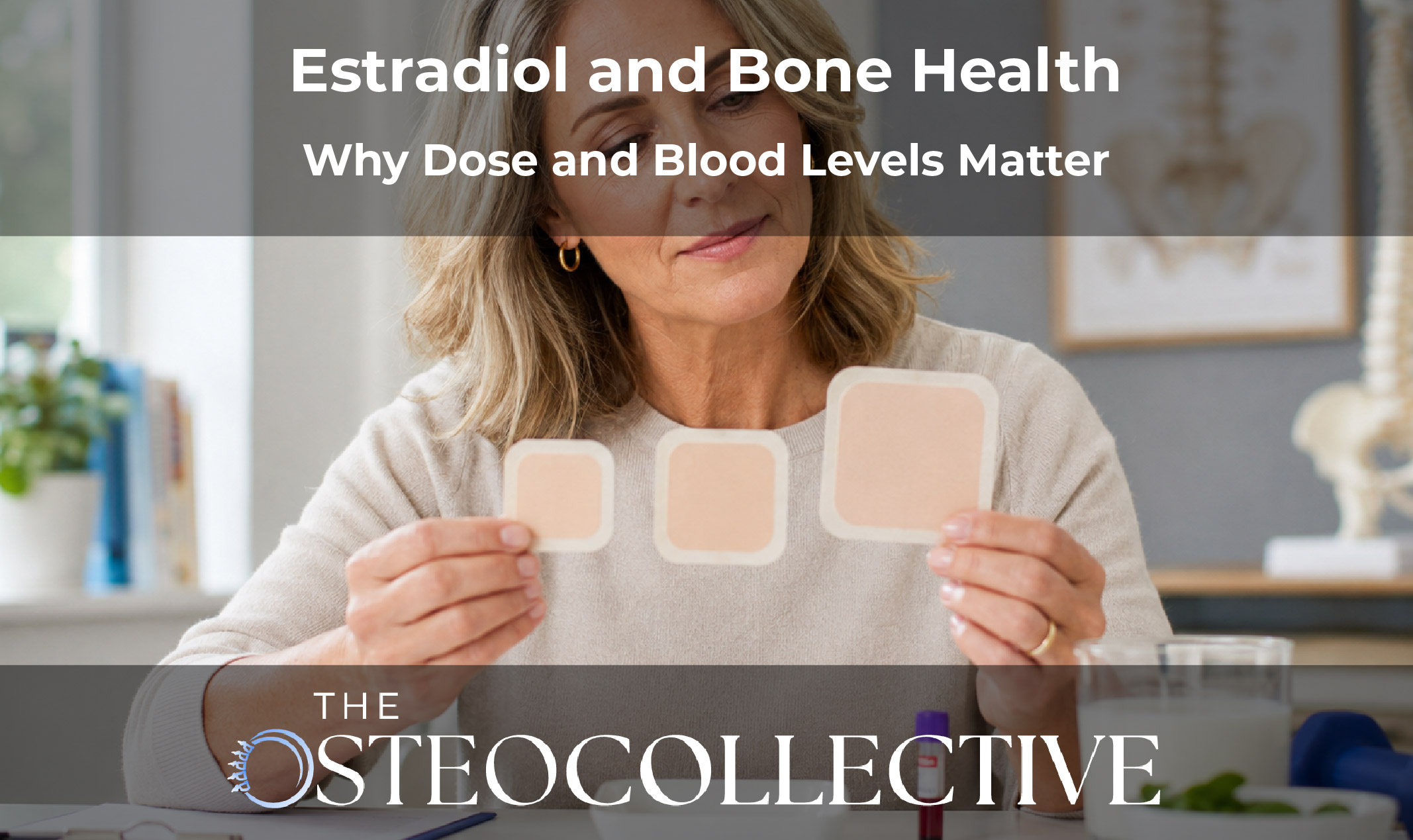
Many women are prescribed a low-dose estradiol patch and told it should protect their bones.
But the problem is that not every woman absorbs or responds the same way.
A prior study looked at different estradiol patch doses, including:
Some people interpret that data to mean a 0.05 mg/day patch is enough for almost everyone.
But that is not the best interpretation.
A 0.05 mg/day patch may be enough for many women, but not all. In some analyses, a meaningful percentage of women did not reach the desired bone-protective threshold on that dose.
Even the 0.075 mg/day patch did not appear to cover everyone.
And even the 0.1 mg/day patch may not be enough for every woman.
That is the key point:
There is no one-size-fits-all estradiol dose.
Some clinicians say hormone levels do not need to be checked.
That may be reasonable if the only goal is symptom management. If a woman’s hot flashes go away, maybe the dose did what it was intended to do.
But bone health is different.
If the goal is to support bone metabolism and reduce fracture risk, symptoms are not enough.
A woman can have fewer hot flashes and still have estradiol levels that are too low for optimal bone support.
This is why measuring estradiol can be useful.
It helps answer:
Estradiol levels are not perfect, but they are useful when interpreted in context.
There is no single magic number.
But some research suggests that estradiol levels around 60 to 80 pg/mL may be associated with better bone metabolism in many women.
That does not mean every woman needs the exact same level.
Some may respond at lower levels. Others may need higher levels. Bone turnover markers, FSH, symptoms, imaging, and clinical context all matter.
So instead of asking only, “What is my estradiol number?” the better question is:
Is my body responding to this estradiol level in a way that supports bone health?
That requires a broader monitoring strategy.
FSH stands for follicle-stimulating hormone.
It is a signal from the brain to the ovaries. When estradiol is low, FSH tends to rise because the brain is asking the ovaries to produce more.
After menopause, FSH is typically elevated.
When estradiol replacement is adequate, FSH may come down.
This can be useful because it gives us another clue about whether the body is sensing enough estradiol.
In many hormone optimization strategies, an FSH under 30 may suggest a meaningful physiologic response. An FSH closer to 20 or below may be even more reassuring in some cases.
FSH is not the only marker that matters, but it can help show whether the brain and body are responding to the hormone dose.
A 2014 randomized controlled trial looked at women with premature ovarian insufficiency, often called POI.
This is a condition where women lose normal ovarian function much earlier than expected.
These women were young, around their early 30s on average, and had lab evidence of low estradiol and high FSH.
This population is important because they are younger and often have fewer age-related medical conditions than older postmenopausal women. That makes it easier to isolate the effect of hormone replacement.
The study used:
There are some important limitations here. The progesterone used was a synthetic progestin, not oral micronized progesterone. That would not be the preferred approach for many hormone-focused clinicians today.
But the estradiol findings are still important.
In the study, women with premature ovarian insufficiency started with lower bone density.
After 36 months of hormone therapy, their bone mineral density improved to the point that it was no longer statistically different from the regularly cycling control group.
That is a powerful finding.
This was not just “preventing bone loss.”
This was restoration toward the expected range.
The spine improved substantially, and the hip also improved.
That matters because women are often told hormones cannot improve bone density. But in a body that is hormone-deficient and hungry for estradiol, restoring estradiol can have a meaningful effect.
Women with premature ovarian insufficiency may respond differently than women who are 10, 20, or 30 years past menopause.
A younger woman with recent hormone loss may have bones that respond quickly when estradiol is restored.
A woman decades past menopause may still benefit from hormone therapy if she is a good candidate, but the response may be slower, more variable, or more complicated by other risk factors.
This is why timing matters.
The earlier hormone deficiency is addressed, the more responsive the system may be.
That does not mean older women cannot benefit.
It means age, timing, cardiovascular risk, years since menopause, fracture history, and overall health have to be considered.
The 2014 study also looked at adding testosterone.
The authors concluded that physiologic transdermal testosterone did not provide additional benefit at the end of three years.
But the details are more interesting.
At the femoral neck, the testosterone group appeared to have stronger results earlier in the study, especially at 12 and 24 months. By 36 months, the difference was no longer statistically significant.
At the spine, testosterone did not appear to add a clear advantage.
This makes sense when you understand that the spine and hip are different types of bone.
The spine contains more trabecular bone, which tends to turn over faster and respond more quickly.
The hip, especially the femoral neck, includes more cortical bone, which may require a stronger anabolic signal and may change more slowly.
Testosterone may be more relevant for some women at the hip or for muscle support, but it is not a blanket solution for everyone.
This is a critical point.
The study did not only treat women who were testosterone deficient. It gave testosterone based on the study design.
That means we do not know whether the women who benefited most were the ones who actually needed testosterone.
In clinical practice, testosterone should not be used casually or automatically.
It should be considered when there is evidence of need, such as:
Even then, dose and monitoring matter.
Too much testosterone can cause side effects, including acne, hair loss, unwanted hair growth, mood changes, voice changes, and other androgenic effects.
For women, testosterone can be useful. But it must be individualized.
One interesting point from the study is that women receiving estradiol and progestin without testosterone saw testosterone levels drop over time.
This is important because estradiol and progesterone therapy can influence the feedback loops that regulate sex hormone production.
Not every woman will need testosterone replacement, but women on estradiol and progesterone should be monitored if symptoms suggest androgen deficiency.
This is especially important for women who are trying to build muscle and bone.
Muscle matters for osteoporosis. If androgen levels are too low, some women may struggle with muscle strength, recovery, and body composition.
The study used medroxyprogesterone acetate, a synthetic progestin.
That is not the same as oral micronized progesterone.
This distinction matters.
Synthetic progestins and bioidentical progesterone can have different effects in the body. Many clinicians who practice hormone optimization prefer oral micronized progesterone when appropriate because it more closely matches the body’s natural progesterone.
Progesterone may also support sleep and nervous system function in ways that synthetic progestins do not.
So while the study is useful, it does not mean the exact protocol used is ideal.
A more modern approach would usually consider:
Hormones matter, but osteoporosis is not only a hormone problem.
Even in studies where estradiol improves bone density, not every woman fully normalizes.
That tells us something important:
Bone loss usually has multiple drivers.
Potential drivers include:
Estradiol may be a major lever, but it is not the only lever.
A complete osteoporosis plan has to look at the whole system.
If estradiol is being used as part of a bone health strategy, it should be monitored thoughtfully.
Useful tools may include:
CTX is a marker of bone breakdown.
P1NP is a marker of bone formation.
Together, they can help show whether bone metabolism is moving in a better direction long before DEXA changes.
DEXA and REMS are still important, but imaging changes slowly. Bone turnover markers can provide earlier feedback.
The right estradiol dose depends on the woman.
A 0.05 mg/day patch may be enough for one woman and not enough for another.
A 0.1 mg/day patch may get one woman to a strong physiologic response while another still does not respond fully.
Absorption varies based on:
This is why the dose should be adjusted based on response, not assumptions.
The question is not, “What dose is standard?”
The question is, “Is this dose producing the physiologic effect we need?”
If you are using hormones for bone health or considering them, ask your provider:
These questions are not meant to challenge your provider. They are meant to make sure the plan is clear.
Estradiol is one of the most powerful tools for bone health, but the right level is not identical for every woman.
Research suggests many women may need estradiol levels higher than what low-dose patches provide if the goal is bone protection or bone improvement. A 0.1 mg/day patch may be powerful for some women, especially those with premature ovarian insufficiency, but even that is not guaranteed to work for everyone.
FSH, estradiol, CTX, P1NP, imaging, symptoms, and clinical context all matter.
Testosterone may help some women, especially when there is true androgen deficiency, but it should not be used as a blanket add-on.
The bigger lesson is simple:
Hormone therapy should be individualized, measured, and integrated into a complete bone health plan.
Because the goal is not just to raise estradiol.
The goal is to build stronger bones, reduce fracture risk, and support a longer, healthier life.
If you are trying to understand whether your hormones are supporting your bones, start with education and testing.
Inside The OsteoCollective, we help members understand how hormones, bone turnover markers, imaging, exercise, nutrition, supplements, and long-term strategy all fit together.
Because osteoporosis is not the end.
But deciding to reverse it is the beginning.
This content is for educational purposes only and is not medical advice. Hormone therapy is not appropriate for everyone and should be individualized based on medical history, menopause status, cardiovascular risk, cancer history, uterine status, symptoms, labs, imaging, and treatment goals. Do not start, stop, or adjust estradiol, progesterone, testosterone, DHEA, or any hormone therapy without guidance from a qualified healthcare professional.

Your Blueprint for Lasting Bone Health and Longevity

.svg)
.svg)
.svg)
.svg)


Join us LIVE October 15th, 2026 at 3:00pm EST to Learn Dr. Doug's proven framework for Osteoporosis Reversal for FREE. Yes! Reversing Osteoporosis is possible and has happened for hundreds of Dr. Doug's patients.
If you have been blind-sided, feel stuck, confused, and exhausted with your diagnosis, this Masterclass is for you!

.svg)

.svg)
