
live better, longer
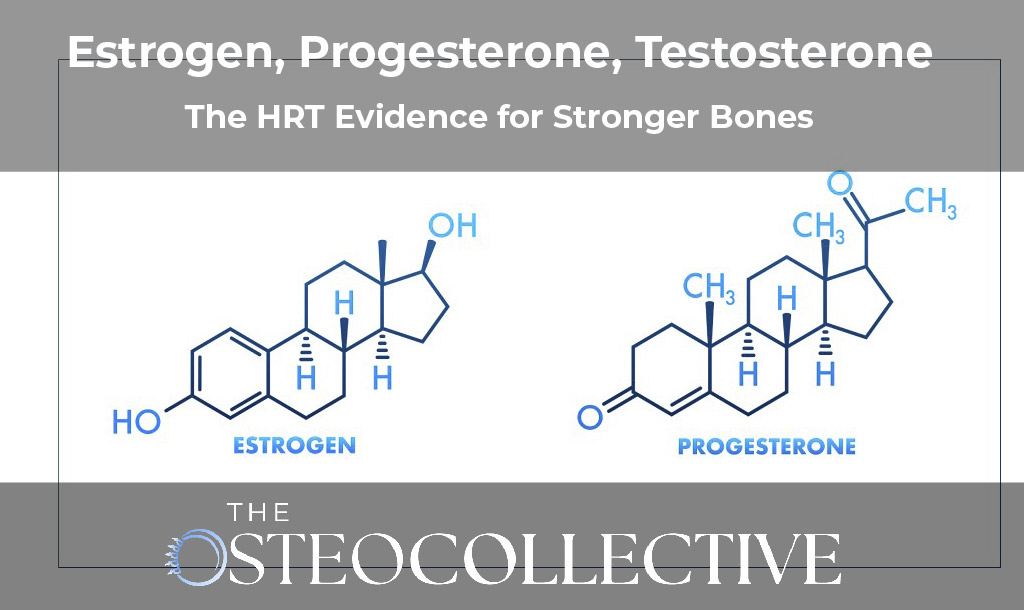
When we talk about building stronger bones, the conversation usually starts with calcium, vitamin D, exercise, and perhaps osteoporosis medications.
But there's another important piece of the puzzle that deserves attention: your hormones.
I've worked with many women who are doing everything they believe is right for their bones. They're eating well, exercising regularly, and taking their supplements. Yet their bone density continues to decline.
What's missing?
Sometimes, we need to look more closely at the hormonal changes happening beneath the surface.
Estrogen, progesterone, and testosterone all interact with the skeletal system, but they don't play identical roles. Understanding these differences can help us make more informed decisions about protecting bone health, particularly during and after menopause.
Let's explore what the research tells us, where hormone replacement therapy (HRT) may fit into an osteoporosis plan, and why an individualized approach matters.
Your bones are constantly changing.
Throughout your life, specialized cells remove old bone while other cells build new bone. This ongoing process, known as bone remodeling, helps maintain skeletal strength.
Estrogen plays an especially important role in keeping this process balanced.
When estrogen levels decline during menopause, bone breakdown can accelerate. Over time, this can contribute to lower bone mineral density and an increased risk of fractures.
This is one reason women often experience more rapid bone loss around the menopausal transition.
And it's why we can't talk about comprehensive bone health without at least discussing hormones.
That doesn't mean every woman needs hormone therapy. It means hormonal health deserves consideration alongside nutrition, exercise, testing, and other treatment options.
Estrogen is probably the most discussed and most misunderstood hormone in menopause.
For years, conversations about hormone therapy have been dominated by concerns about breast cancer, blood clots, cardiovascular disease, and other potential risks.
Those concerns deserve serious attention.
But focusing exclusively on risks can leave out an important part of the conversation: estrogen's established role in protecting bone.
Research has demonstrated that menopausal hormone therapy can reduce bone loss and fractures. Certain estrogen products are also FDA-approved for the prevention of postmenopausal osteoporosis, although they are not approved specifically to treat established osteoporosis.
That's an important distinction.
When we're considering hormone therapy, we're not talking about an experimental idea with no supporting research. We're discussing a treatment with documented skeletal benefits that must be weighed against its potential risks.
Estradiol is one of the primary forms of estrogen produced during a woman's reproductive years.
It helps regulate the activity of bone-removing cells, supporting the balance between bone breakdown and formation.
When estradiol declines, this balance can shift toward greater bone loss.
Clinical evidence shows that systemic estrogen therapy can help preserve bone mineral density and reduce fracture risk in appropriately selected postmenopausal women.
However, whether hormone therapy is appropriate depends on several factors, including a woman's age, medical history, time since menopause, and individual risk profile.
The goal isn't simply to increase estrogen. It's to determine whether hormone therapy offers a meaningful benefit for a particular person.
One question I believe deserves more attention is whether a hormone treatment is actually accomplishing its intended goal.
Not all hormone formulations, doses, or delivery methods produce the same effects.
A low-dose estrogen regimen may be appropriate for managing certain menopausal symptoms, but that doesn't automatically mean every regimen provides equivalent skeletal protection.
This is where clinical monitoring becomes important.
We need to consider the specific product, the research supporting its dose, and whether the patient's bone health is responding as expected.
However, there is no universally accepted estradiol blood-level target that guarantees bone protection. A single laboratory result cannot tell us everything about someone's bone health or establish that a higher hormone dose is necessary.
You may have heard of compounded hormone products such as BiEst, which typically combine estradiol and estriol.
Although both are estrogens, they have different biological properties.
Estradiol has much stronger clinical evidence supporting its use in preventing postmenopausal bone loss.
Estriol does not have comparable evidence establishing it as an effective osteoporosis treatment or substitute for proven bone-protective therapies.
This is why I encourage patients to look beyond a hormone product's name or marketing claims.
The important question is whether the specific treatment has evidence supporting the outcome you're trying to achieve.
Progesterone is another hormone that frequently comes up when discussing HRT.
Its best-established role in menopausal hormone therapy is protecting the uterine lining.
For women who have a uterus, taking systemic estrogen without adequate endometrial protection can increase the risk of endometrial hyperplasia and cancer.
An appropriately prescribed progestogen helps reduce that risk. Women who have undergone a hysterectomy generally do not require a progestogen for this purpose.
But progesterone also raises interesting questions about bone biology.
Researchers have investigated its possible influence on bone formation and other physiological processes. However, evidence that progesterone alone prevents fractures or meaningfully treats osteoporosis remains limited.
An important distinction is that natural progesterone and synthetic progestins are not identical.
Micronized progesterone is chemically identical to the progesterone produced by the human body. Synthetic progestins include several different compounds, each with its own characteristics.
Some research suggests micronized progesterone may have a more favorable breast-risk profile than certain synthetic progestins, particularly medroxyprogesterone acetate. However, long-term comparative evidence remains incomplete.
These findings do not establish that progesterone prevents breast cancer or that all synthetic progestins have the same risks.
The formulation matters, but so does the patient's individual history.
Hormone therapy can be prescribed using continuous or cyclic regimens.
With cyclic therapy, progesterone or another progestogen is taken during specific days of the month rather than every day. This may produce scheduled withdrawal bleeding.
Both continuous and cyclic regimens have established clinical uses.
Although older hormone studies explored different dosing schedules, there isn't sufficient evidence to conclude that cycling progesterone consistently produces better bone outcomes than continuous therapy.
The most appropriate schedule depends on factors such as menopausal status, estrogen dose, bleeding patterns, and endometrial protection.
Any unexpected or persistent bleeding after menopause should be discussed with a healthcare professional rather than automatically attributed to hormone treatment.
Let's move beyond estrogen and progesterone for a moment.
DHEA, or dehydroepiandrosterone, is a hormone produced primarily by the adrenal glands.
It serves as a precursor that the body can convert into other hormones, including testosterone and estrogen.
DHEA levels generally decline with age, which has prompted researchers to investigate whether supplementation could influence bone health.
And some findings are interesting.
A randomized trial involving older adults found that DHEA supplementation, combined with calcium and vitamin D, improved lumbar spine bone mineral density in women. However, the researchers did not observe comparable improvements at the hip.
That raises an important question: Could DHEA have a useful role in certain bone-health treatment plans?
Possibly, but we need to be careful about interpreting the findings.
The studies have generally been relatively small, results are not uniform across skeletal sites, and evidence demonstrating fracture prevention is lacking.
DHEA is also available over the counter in the United States, but that doesn't make it appropriate for everyone.
Because it can influence sex hormone levels, supplementation requires particular caution in people with hormone-sensitive medical conditions.
I view DHEA as an area worth understanding, not something every woman with osteoporosis should automatically add to her routine.
Testosterone is usually associated with men's health, but women produce testosterone too.
It plays roles in several physiological processes, and researchers have explored whether it could help maintain muscle and skeletal health.
The challenge is separating biological potential from demonstrated clinical benefits.
Some smaller studies have investigated testosterone alongside estrogen therapy. However, larger, high-quality studies have not established that testosterone treatment improves bone mineral density or prevents fractures in women.
An international consensus statement concluded that the available evidence does not support a bone-density benefit from testosterone therapy at physiological doses after 12 months.
The principal evidence-based indication for testosterone therapy in women is hypoactive sexual desire disorder (HSDD), following an appropriate clinical assessment.
There is currently no FDA-approved testosterone product specifically formulated for women in the United States.
That doesn't mean research should stop. It means we need stronger evidence before promoting testosterone as an established osteoporosis treatment.
Treatment also requires careful consideration of potential adverse effects, including acne, increased facial or body hair, and excessive testosterone exposure. Long-term cardiovascular and breast safety data remain limited.
Pellets present an additional consideration because the implanted dose cannot be easily adjusted or discontinued after insertion.
For women receiving testosterone for an appropriate indication, international consensus guidance favors formulations that maintain physiological concentrations and advises against preparations that produce excessively high levels.
This makes appropriate prescribing and follow-up particularly important.
Testosterone also plays a role in maintaining skeletal health in men.
Men with clinically diagnosed hypogonadism may experience reduced bone density, and testosterone treatment can improve certain measures of bone density and structure.
But there's an important difference between improving bone density and preventing fractures.
A large randomized trial published in 2024 followed more than 5,000 middle-aged and older men with hypogonadism.
Testosterone treatment did not reduce clinical fractures compared with placebo. In fact, fractures occurred more frequently in the testosterone group during the study.
This reinforces a principle that applies to both men and women: hormone treatment should not automatically replace proven osteoporosis therapies when fracture prevention is the primary goal.
This is one of the most important questions we can ask.
And the answer isn't a simple yes or no.
Hormone therapy has meaningful benefits for certain individuals, but its risks vary according to age, timing, formulation, dose, medical history, and route of administration.
For example, observational evidence suggests transdermal estrogen may carry a lower risk of blood clots than oral estrogen, although comparative randomized evidence is limited.
The Menopause Society also reports that the benefit-risk balance is generally more favorable for women younger than 60 or within 10 years of menopause, provided they have no contraindications.
A thorough discussion should consider:
Hormone therapy should not be used to prevent heart disease or dementia, and women with certain medical conditions may need to avoid systemic hormone therapy altogether.
The goal is to make decisions based on the complete clinical picture rather than fear or enthusiasm alone.
Here's what I want you to remember.
Your hormones can influence your bones, but they represent just one part of a much larger system.
If you're experiencing bone loss, the solution isn't necessarily to start hormones, increase a dose, or add another supplement.
We need to understand what's contributing to the problem in the first place.
That means looking at your bone density, fracture history, possible secondary causes of osteoporosis, nutritional status, exercise routine, and other relevant medical factors.
It also means understanding when established osteoporosis medications may be necessary, particularly for individuals at high or very high fracture risk.
And when hormone therapy is being considered, we need to ask whether it fits your goals and whether its potential benefits outweigh its risks.
Stronger bones aren't built by chasing one hormone number. They're supported by understanding the entire system and choosing interventions that have evidence behind them.
That's the approach I want more people to understand.
If you've been trying to make sense of your bone density results, hormone levels, supplements, and treatment options, you don't have to piece everything together on your own.
In our free Bone Health Masterclass, we explore the essential components of a comprehensive bone health plan and help you understand the questions worth asking about your own health.
You'll learn how bone testing, nutrition, exercise, hormones, and treatment decisions fit into the bigger picture.
Your bone health deserves more than a one-size-fits-all approach.

Your Blueprint for Lasting Bone Health and Longevity

.svg)
.svg)
.svg)
.svg)


Join us LIVE September 24th, 2026 at 3:00pm EST to Learn Dr. Doug's proven framework for Osteoporosis Reversal for FREE. Yes! Reversing Osteoporosis is possible and has happened for hundreds of Dr. Doug's patients.
If you have been blind-sided, feel stuck, confused, and exhausted with your diagnosis, this Masterclass is for you!

.svg)

.svg)
