
live better, longer
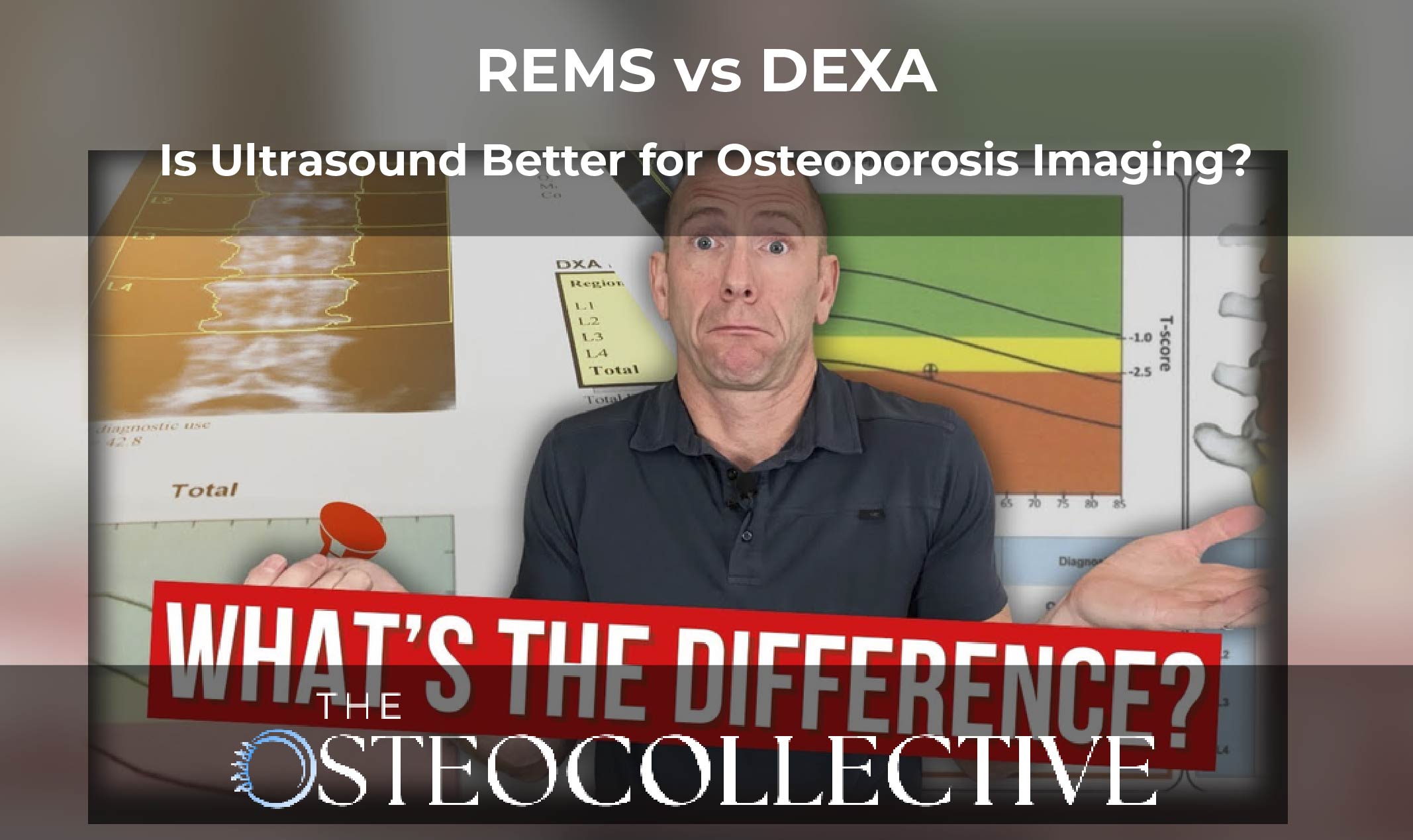
REMS may offer a more precise and potentially more complete way to evaluate bone health compared with DEXA, especially when there is confusion between hip and spine results. DEXA is still the current standard for osteoporosis diagnosis, but it only measures bone density. REMS uses ultrasound and may provide information about both bone density and bone quality.
A newer study found that REMS had far less hip-spine discordance than historical DEXA data. In that study, there were no major discordance cases among more than 1,800 REMS exams, while some DEXA studies report major discordance rates as high as 17%. This matters because large differences between hip and spine scores can lead to confusion, misclassification, anxiety, and potentially unnecessary drug treatment.
REMS is not perfect, and it does not make DEXA useless. But it may be an important tool for patients who want a clearer picture of bone density, bone quality, and fracture risk.
Most people diagnosed with osteoporosis are diagnosed through a DEXA scan.
A DEXA scan measures bone mineral density and gives you a T-score. That T-score is then used to classify your bone health as normal, osteopenia, or osteoporosis.
But DEXA has limitations.
Some people get a report where the spine looks terrible, but the hip looks normal. Others have one scan showing osteoporosis, then another tool like REMS shows normal bone. That creates a real problem.
Patients are left asking:
This is where understanding accuracy, precision, and discordance becomes important.
DEXA stands for dual-energy X-ray absorptiometry.
It is currently the most common imaging test used to diagnose osteoporosis and osteopenia. It uses low-dose X-ray technology to estimate bone mineral density.
DEXA typically measures:
DEXA is widely available, inexpensive compared with other imaging, and used in most clinical guidelines.
But DEXA mainly measures density.
It does not directly measure bone quality.
That matters because fracture risk is not only about how dense your bones are. It is also about the structure, architecture, collagen matrix, mineralization, turnover, and overall quality of the bone.
REMS stands for radiofrequency echographic multi-spectrometry.
It is an ultrasound-based technology used to evaluate bone health. The most well-known REMS system comes from the company Echolight.
Unlike DEXA, REMS does not use radiation.
REMS can evaluate areas such as the:
A REMS report can provide:
This makes REMS interesting because it may help answer questions that DEXA cannot fully answer.
To understand DEXA vs REMS, we need to define two terms: accuracy and precision.
Accuracy means how close a measurement is to the true value.
Think of throwing a dart at a dartboard. If you hit the bullseye, you are accurate.
Precision means how consistently you hit the same spot.
If you throw five darts and they all land close together, you are precise. But if they all land far from the bullseye, you are precise but not accurate.
This distinction matters in bone imaging.
A tool can be precise without being perfectly accurate. A tool can also be considered accurate compared with a standard but still have measurement variation.
DEXA is considered the current gold standard, but it is not perfectly precise. REMS appears to be very precise, meaning repeat scans often produce very similar results.
But because DEXA is still the standard, it is difficult to say REMS is “more accurate” in an absolute sense.
The better statement is:
REMS may be more precise and may provide additional bone quality information that DEXA does not provide.
Hip-spine discordance means the hip and spine results do not match.
For example:
This matters because osteoporosis is usually a systemic bone metabolism issue.
In general, if someone has osteoporosis, we expect the skeleton to show a more consistent pattern. The spine may be worse than the hip in many cases, but a huge difference between sites raises questions.
Sometimes discordance is real.
But sometimes it may be caused by:
The bigger the mismatch, the more important it is to ask whether one result may be misleading.
Discordance is often divided into minor and major categories.
Minor discordance means the hip and spine are one diagnostic category apart.
For example:
Major discordance means the hip and spine are two diagnostic categories apart.
For example:
Major discordance is more concerning because it suggests a much wider mismatch.
If one part of the body looks completely normal and another part looks severely osteoporotic, that result needs careful review.
A 2023 study looked at the prevalence of major and minor discordance between hip and spine T-scores using REMS.
The study included 1,855 patients who had a REMS examination between 2018 and 2022.
The researchers then compared the REMS discordance rates to historical DEXA data.
The findings were important.
Among more than 1,800 REMS exams, there were no cases of major discordance.
That means there were no cases where one site was normal and another site showed osteoporosis.
By comparison, some DEXA studies report major discordance rates as high as 17%.
That is a big difference.
Minor discordance with REMS was a little over 15%.
In DEXA literature, minor discordance has been reported much higher, often between 38% and 51%.
So REMS showed much less mismatch between the hip and spine than DEXA historical data.
Lower discordance matters because it may reduce confusion and misclassification.
If a DEXA scan says your spine is osteoporotic but your hip is normal, your doctor may diagnose you with osteoporosis and recommend medication.
That might be appropriate.
But if the discordance is very large, it is also possible that one measurement is not giving the full truth.
For example, a spine T-score of -3.0 with a hip T-score of -0.5 is a major mismatch.
That does not automatically mean the spine result is wrong.
But it does mean the scan should be reviewed carefully, especially if treatment decisions are being made based on that one number.
Misclassification is not just a technical problem.
It can change a person’s life.
A diagnosis of osteoporosis can create:
If the diagnosis is based on a questionable measurement, the patient may be treated unnecessarily.
That matters because osteoporosis drugs can be useful, but they can also have risks, side effects, and long-term sequencing challenges.
Nobody should be put on a drug because of a misleading scan if better information is available.
This is the tricky part.
We cannot definitively say REMS is more accurate than DEXA because DEXA is still considered the gold standard.
When a new tool is compared against the gold standard, researchers usually ask whether the new tool agrees with the existing standard.
But if the existing standard has limitations, that creates a problem.
DEXA is not perfect.
It can be affected by:
So if REMS and DEXA disagree, it is not automatically clear which one is “wrong.”
The better way to think about this is:
REMS may provide a more precise and potentially more complete assessment, especially when DEXA results look inconsistent or confusing.
Another interesting point is that REMS may show improvement faster than DEXA.
Why?
DEXA relies on mineralized bone density. It needs bone to be mineralized enough for the X-ray-based measurement to detect it.
REMS uses ultrasound, which may detect changes in the bone matrix and bone quality earlier.
That means REMS may be able to pick up changes before DEXA shows improvement.
This is important because bone building is not instant.
When bone is being remodeled, the body has to break down old bone and lay down new bone. That new bone does not become fully mineralized immediately.
So in some cases, DEXA may look worse before it looks better, especially early in a bone-building program.
REMS may provide a different window into that process.
One of the strongest arguments for REMS is that it may provide information about both density and quality.
DEXA primarily gives us density.
But bone strength depends on:
REMS may help provide a more complete picture by evaluating ultrasound signal patterns that relate to bone condition.
This does not mean REMS replaces every other tool.
But it may help fill gaps left by DEXA.
Not necessarily.
DEXA is still useful.
It is the standard diagnostic tool, widely available, and recognized by medical guidelines. If your insurance, physician, or treatment plan requires DEXA, it may still be necessary.
But REMS may be especially useful if:
In an ideal world, some patients may benefit from both.
DEXA gives standard density data. REMS adds quality and fragility-related context.
You should be careful.
A DEXA T-score and a REMS T-score are not the same measurement from the same technology.
If your DEXA says -2.8 and your REMS says -1.8, that does not automatically mean you gained a full T-score.
It means two different technologies produced different estimates.
The best way to track progress is:
Comparing REMS directly to DEXA can create confusion if you do not understand the difference between the tools.
If your DEXA and REMS disagree, do not panic.
Instead, ask better questions:
A disagreement does not mean one test is useless.
It means you need interpretation.
Imaging is important, but imaging changes slowly.
That is why bone turnover markers can be so useful.
Two of the most helpful markers are:
These can help show what is happening with bone metabolism before imaging changes.
If REMS is improving, DEXA is unchanged, and bone turnover markers look favorable, that may suggest the plan is moving in the right direction.
If DEXA looks worse but markers look strong and REMS looks better, it may be worth waiting and reassessing before assuming failure.
The point is not to rely on one number.
The point is to build a complete picture.
No single test tells the whole story.
A strong osteoporosis assessment may include:
This is especially important if you are trying to reverse osteoporosis naturally or through a health span-focused program.
A drug-based approach may rely heavily on periodic DEXA scans.
But a comprehensive bone-building program needs more frequent feedback.
DEXA is still the standard tool for diagnosing osteoporosis, but it has limitations.
REMS is an ultrasound-based technology that may provide a more precise and more complete picture of bone health by giving information about both bone density and bone quality.
A 2023 study found that REMS had much lower hip-spine discordance than historical DEXA data, with no major discordance among more than 1,800 REMS exams.
That matters because hip-spine discordance can lead to confusion, misclassification, anxiety, and potentially unnecessary treatment.
REMS does not make DEXA obsolete.
But for many patients, especially those with confusing scan results, REMS may be a valuable second look.
The best approach is not to trust one test blindly.
The best approach is to use the available data together, including imaging, bone turnover markers, fracture history, and clinical context.
Because the goal is not just a better scan.
The goal is stronger bones, lower fracture risk, and a clearer path forward.
REMS is an ultrasound-based technology that assesses bone health. It can provide T-scores, bone density estimates, fragility information, and bone quality-related data without radiation.
REMS may be more precise and may provide more information about bone quality, but DEXA is still the current standard for osteoporosis diagnosis. REMS can be especially helpful when DEXA results are confusing or discordant.
Hip-spine discordance means the hip and spine results do not match. For example, the spine may show osteoporosis while the hip shows normal bone density or osteopenia.
Discordance matters because it can lead to misclassification. A person may be diagnosed with osteoporosis based on one site even if another site looks normal, which may influence medication decisions.
Not always. DEXA is still widely used in guidelines and insurance systems. REMS may be best used as an additional tool, especially when more information about bone quality or scan consistency is needed.
Possibly. REMS may detect changes in bone quality or matrix earlier than DEXA, which depends on mineralized bone density. However, progress should still be interpreted with clinical context.
Be careful. REMS and DEXA are different technologies. It is better to compare DEXA to DEXA over time and REMS to REMS over time.
Review the scans with a qualified clinician. Consider image quality, positioning, arthritis, scoliosis, fracture history, bone turnover markers, and overall clinical risk before making treatment decisions.
If your DEXA results do not make sense, or if you are confused because your REMS and DEXA do not match, do not make decisions from one number alone.
Inside The OsteoCollective, we help members understand how imaging, bone turnover markers, hormones, nutrition, exercise, supplements, and long-term strategy all fit together.
Because osteoporosis is not the end.
But deciding to reverse it is the beginning.
This content is for educational purposes only and is not medical advice. Bone imaging should be interpreted by a qualified healthcare professional who understands DEXA, REMS, TBS, fracture risk, medications, bone turnover markers, and your full medical history. Do not start, stop, or change osteoporosis medications, supplements, hormones, or exercise plans based only on one imaging result.

Your Blueprint for Lasting Bone Health and Longevity

.svg)
.svg)
.svg)
.svg)


Join us LIVE October 15th, 2026 at 3:00pm EST to Learn Dr. Doug's proven framework for Osteoporosis Reversal for FREE. Yes! Reversing Osteoporosis is possible and has happened for hundreds of Dr. Doug's patients.
If you have been blind-sided, feel stuck, confused, and exhausted with your diagnosis, this Masterclass is for you!

.svg)

.svg)
